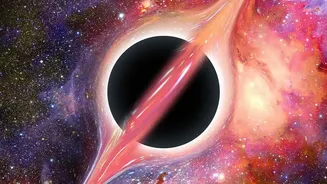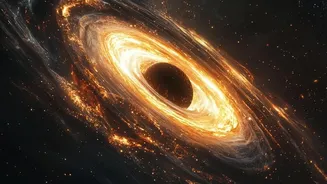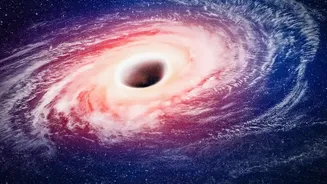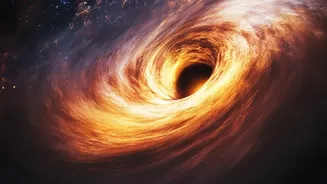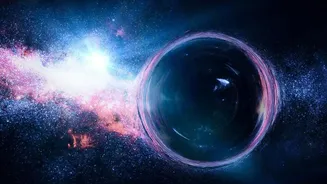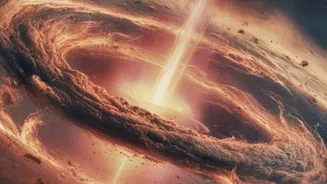

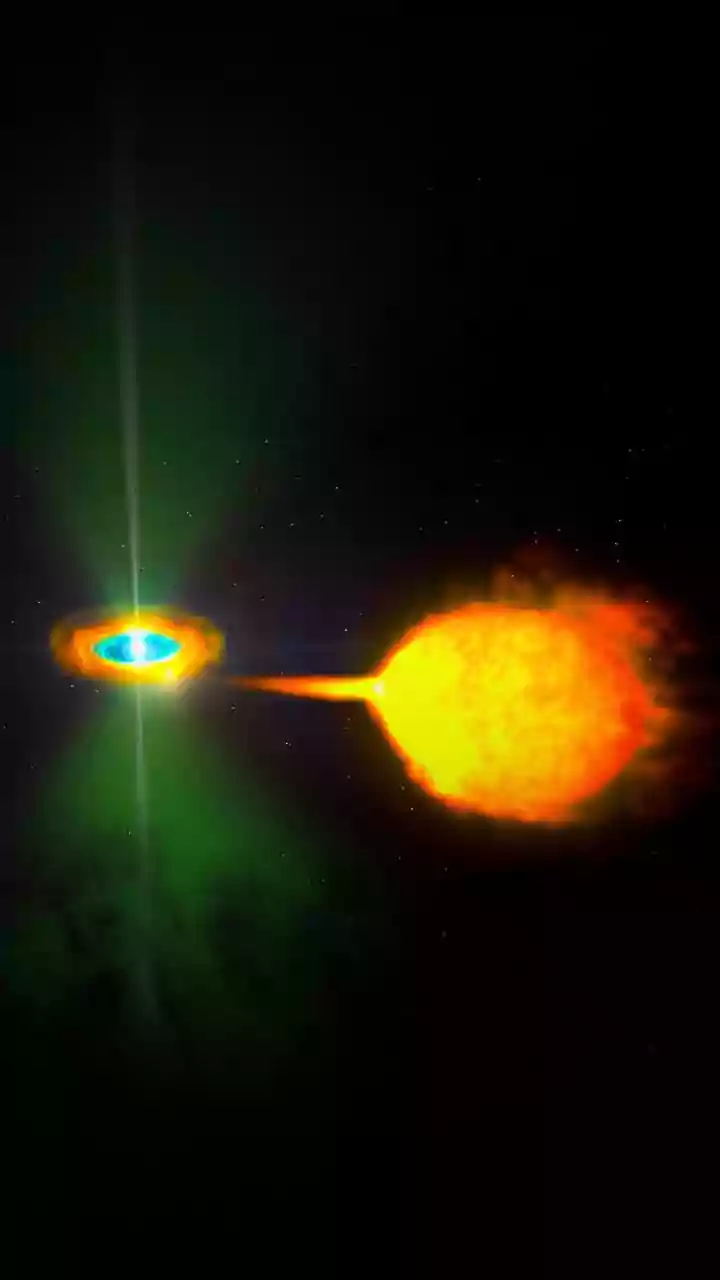


The universe is filled with objects of unimaginable scale, but some are so large they challenge our understanding of physics. Enter the 'Stupendously Large Black Hole,' a theoretical monster that makes its supermassive cousins look small.
Beyond Supermassive: A New Class of Giant
Most people are
familiar with the concept of supermassive black holes (SMBHs). These are the giants that sit at the center of nearly every large galaxy, including our own Milky Way, where Sagittarius A* weighs in at about four million times the mass of our sun. Some SMBHs are even classified as 'ultramassive', tipping the scales at over 10 billion solar masses. But theoretical physicists have wondered: is there an even larger class? This question gave rise to the concept of Stupendously Large Black Holes, or SLABs. These are hypothetical objects with masses starting at 100 billion solar masses and potentially reaching into the trillions, quintillions, or even more. An object this massive would be larger than some entire galaxies, a true titan of the cosmos.
The Theoretical Case for SLABs
So, why do scientists even entertain the idea of such colossal objects? The theories behind SLABs are tied to the earliest moments of the universe. One leading idea is that they are a type of 'primordial black hole' (PBH), formed not from a collapsing star but from immense density fluctuations just moments after the Big Bang. Standard black hole growth is limited by something called the Eddington Limit, where the radiation pressure from infalling matter pushes away new material, effectively putting a speed limit on how fast it can 'eat'. For a black hole to reach SLAB proportions through this conventional method, it would take longer than the current age of the universe. Primordial formation offers a way around this, suggesting SLABs could have been born massive from the very start.
The Hunt for Evidence
A fascinating theory is one thing, but scientific proof is another. The headline-making 'latest report' refers to a growing body of research that uses clever methods to hunt for these invisible giants. One recent approach involves looking for their shadows against the Cosmic Microwave Background (CMB), the faint afterglow of the Big Bang. A SLAB would be so massive that its shadow would be detectable as a 'negative source' or a cold spot in the CMB's otherwise uniform glow. Other search methods include looking for the extreme gravitational lensing effects they would have on distant galaxies—bending light in a way that would be unmistakable—or searching for the gamma-ray halos produced by the annihilation of dark matter particles trapped in their immense gravitational fields.
What the Latest Findings Suggest
Despite these ingenious search methods, the conclusion remains the same: there is currently no direct, verifiable evidence that SLABs exist. Recent analyses of the CMB, for instance, have not found the kind of 'grainy' texture or large-scale cold spots that a universe populated with SLABs would create. These null results are incredibly important. While they don't definitively rule out the existence of SLABs entirely, they place powerful constraints on how many of them could be out there and how massive they could be. For example, some studies have effectively ruled out SLABs as a major component of the mysterious dark matter that constitutes most of the matter in the universe. The verdict from the scientific community is clear: for now, these stupendous objects remain firmly on the drawing board.