


The Cosmic Stretch: What Is a Light Shift?
Imagine the sound of an ambulance siren changing pitch as it speeds away. The sound waves stretch, making the pitch lower. Light behaves similarly. Since the Big Bang, the universe has been expanding, stretching the very fabric of space. As light from
a distant galaxy travels across billions of years to reach us, the space it's moving through expands, and this stretches the light waves along with it. This phenomenon is called cosmological redshift. Light that might have been emitted as blue or even ultraviolet is stretched to longer, redder wavelengths, eventually shifting into the infrared part of the spectrum. The farther away a galaxy is, the more its light has been stretched and the greater its redshift. This makes redshift a crucial measuring stick for cosmic distances.
Staring into Nothing: The 'Deep Field'
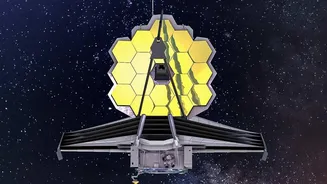
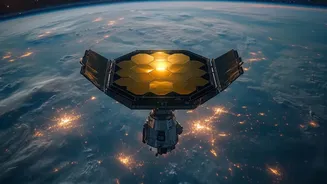
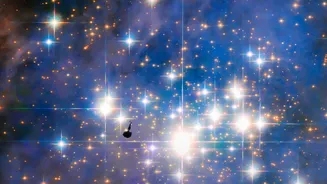
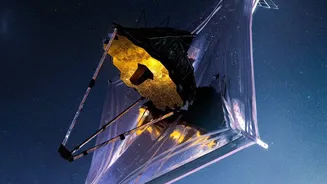
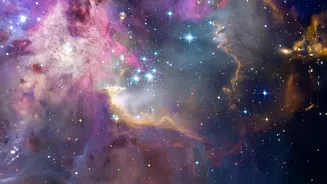
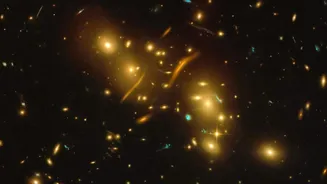
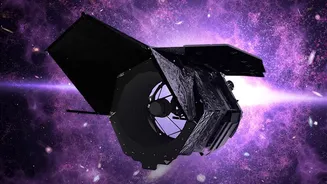
To find these incredibly remote objects, astronomers point the Webb telescope at a seemingly empty patch of the sky, a strategy pioneered by the Hubble Space Telescope. They then conduct a 'deep field' observation, which is essentially a very long-exposure image, sometimes lasting for many hours. This allows the telescope's sensitive instruments to collect the faint, ancient light from galaxies that are too distant and dim to be seen otherwise. What appears to be a tiny, dark spot in the sky reveals itself to be filled with thousands of galaxies, some seen as they were over 13 billion years ago. Webb's advanced infrared capabilities allow it to peer deeper into these fields than ever before, cutting through cosmic dust to uncover the universe's earliest structures.
Webb's Specialist Tool: The Spectrograph
Seeing the faint red dots in a deep field image is just the first step. To precisely measure the light shift, or redshift, scientists use an instrument called a spectrograph. Webb is equipped with the Near-Infrared Spectrograph (NIRSpec), one of the most powerful ever built. A spectrograph works like a prism, splitting the incoming light from a single galaxy into its constituent wavelengths, creating a spectrum. This spectrum isn't a smooth rainbow; it has dark or bright lines imprinted on it. These lines are like chemical fingerprints, corresponding to specific elements like hydrogen or oxygen, which absorb or emit light at very precise, known wavelengths.
Decoding the Fingerprints in Light
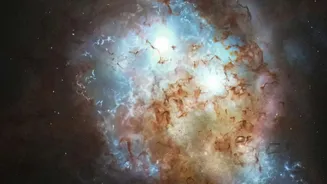
These chemical fingerprints are the key to unlocking a galaxy's distance. Scientists know where, for example, a hydrogen line should appear in the spectrum. But in a distant galaxy, that line will be shifted toward the red end of the spectrum due to cosmic expansion. By measuring how far the line has been shifted, astronomers can calculate the galaxy's redshift value. The higher the redshift number, the more the light has been stretched, meaning the galaxy is farther away and we are seeing it as it was much earlier in cosmic history. For instance, a galaxy recently identified by Webb, JADES-GS-z14-0, has a redshift of 14.32, meaning we are observing it as it was less than 300 million years after the Big Bang.
From Faint Light to Cosmic History
The process brings all these concepts together. First, Webb's camera (NIRCam) takes a deep field image to identify candidate distant galaxies. Then, the telescope focuses on these targets and feeds their light to the NIRSpec instrument. A revolutionary piece of technology called a microshutter array, a grid of a quarter-million tiny windows, allows NIRSpec to simultaneously capture spectra from up to 200 individual galaxies in a single observation. Scientists analyze these resulting spectra, identify the chemical fingerprints, measure their shift, and calculate the redshift. This process not only reveals the galaxy's distance and age but also its chemical composition, temperature, and mass, providing a detailed picture of how the first stars and galaxies formed and evolved.