




A Flood of Galactic Proportions
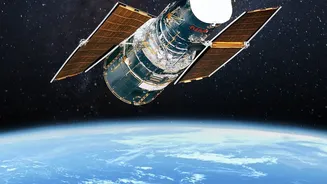
Modern marvels like the James Webb Space Telescope (JWST) and a growing fleet of Earth-observing satellites are capturing the cosmos in unprecedented detail. This incredible capability comes with a colossal challenge: data volume. These instruments generate
immense quantities of information, with some missions collecting terabytes of data daily. Just recently, NASA announced its participation in the Genesis Mission, a project aiming to process over 150 petabytes of space data using AI. This explosion of information is far too vast for human analysts to manually sift through. According to one NASA official, without new technology, the agency would face significant backlogs, potentially missing crucial details buried within the noise. Trying to find a single supernova or a potentially hazardous asteroid in this mountain of data is like looking for a specific grain of sand on a planet-sized beach. This is where artificial intelligence becomes less of a futuristic concept and more of a mission-critical necessity.
AI: The Ultimate Mission Control Assistant
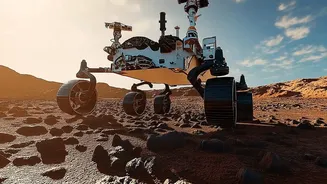
Artificial intelligence, particularly machine learning, excels at recognizing patterns in enormous datasets, a task that would take human scientists years to complete. Instead of replacing human experts, AI acts as a powerful assistant. These algorithms can be trained to perform specific tasks, such as classifying galaxies, identifying the light signatures of distant exoplanets, or spotting anomalies in satellite imagery that could signal a natural disaster on Earth. For example, the ExoMiner deep learning system analyzed data from the Kepler Space Telescope and identified 301 new exoplanets that had previously been missed. Similarly, AI is helping to make spacecraft more autonomous. The Perseverance rover on Mars uses AI to analyze terrain and navigate safely without real-time human control, with 88% of its driving being autonomous.
AI Models in Action
NASA is not just theorizing about AI; it's actively deploying it. In partnership with IBM, the agency released an open-source geospatial AI foundation model called Prithvi. Trained on years of NASA's satellite imagery of Earth, this model can help track everything from changes in land use and flood mapping to predicting crop yields. Beyond Earth, AI models like Morpheus are used to analyze the pixel-by-pixel data from the James Webb Space Telescope, helping scientists classify the billions of stars and galaxies it observes. More recently, AI has even helped sharpen JWST's vision; a software tool called AMIGO corrected image blurring in one of the telescope's key instruments, a fix made entirely with code from Earth. These tools dramatically reduce analysis times, turning tasks that once took years into days.
Smarter Satellites and Safer Skies
AI is also making satellites themselves more efficient. Onboard processing allows a satellite to analyze data in real-time and decide what information is important enough to send back to Earth. This is crucial given the limited communication bandwidth between deep space and ground stations. This onboard intelligence can save huge amounts of data storage and transmission time by, for example, skipping images of clouds to focus only on the ground below. This same pattern-recognition capability is being turned toward planetary defense. AI algorithms are being developed and tested to help scientists detect and track near-Earth objects (NEOs) much faster and more accurately than human observers alone. Programs like NEO AID and Sentry-II are designed to sift through telescope images, identify potential threats, and calculate impact probabilities, giving us a better chance to react if an asteroid were on a collision course with Earth.
The Future of Cosmic Discovery
The integration of AI into space exploration is still evolving, and it comes with challenges. AI models require vast amounts of high-quality data for training, and operating complex systems in the harsh environment of space is a significant hurdle. Furthermore, ensuring the reliability and security of autonomous AI systems is a top priority. Despite these obstacles, the path forward is clear. NASA is developing foundation models for various scientific fields, including heliophysics and planetary science, signaling a deeper integration of AI across all its missions. The goal is not just to manage data, but to create a symbiotic partnership where AI handles the heavy lifting of data processing, freeing up human scientists to focus on interpretation, hypothesis, and the grand work of discovery.