



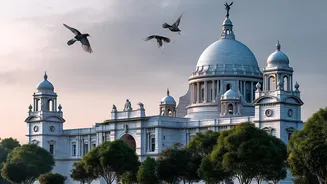
Victoria Memorial: The White Marble Marvel
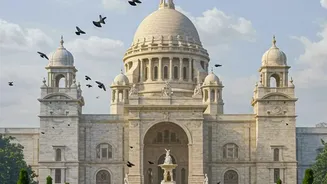
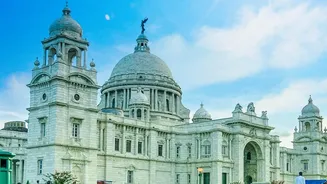
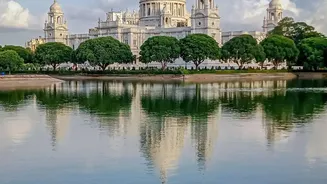
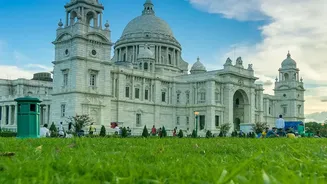
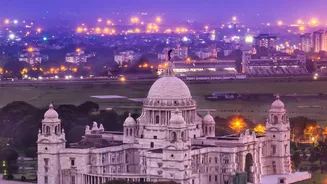
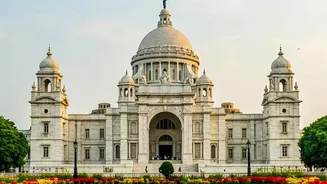
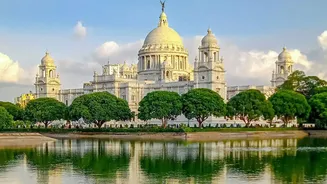
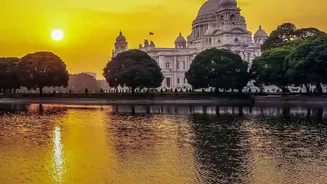
No architectural tour of Kolkata is complete without a visit to the Victoria Memorial. Conceived by Lord Curzon after the queen's death in 1901, this breathtaking monument of white Makrana marble was envisioned as a tribute to her reign. Designed by Sir
William Emerson, it seamlessly blends European classical styles with Mughal elements, a nod to its Indian setting, resulting in a unique Indo-Saracenic design. Though the capital had shifted to Delhi by the time it was completed in 1921, the memorial remains the city’s most iconic landmark. Today, it serves as a museum with 25 galleries showcasing everything from colonial-era paintings and manuscripts to artefacts related to the Indian independence movement. Set within 64 acres of lush gardens, the structure, topped by the bronze 'Angel of Victory', is a must-see.
Writers' Building: The Red-Brick Epicentre of Power
Stretching across the entire northern length of Lal Dighi, the Writers' Building, with its imposing red-brick facade, was the nerve centre of British administration. Designed by Thomas Lyon in 1777, it was originally built to house the junior clerks, or 'writers', of the East India Company. Over the decades, it expanded from a functional office into the powerful secretariat of the Bengal government, witnessing pivotal moments in Indian history, including a famed attack by revolutionaries Benoy, Badal, and Dinesh in 1930. Its Greco-Roman architectural style, complete with grand porticos and statues of Greek gods, was meant to project imperial authority. While the state secretariat has since moved, the building remains a potent symbol of governance and Kolkata's political past.
B.B.D. Bagh: The Colonial Heart
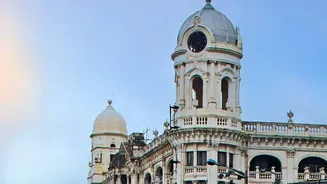
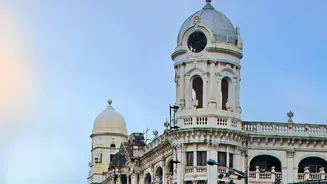
The area surrounding the Writers' Building, formerly known as Dalhousie Square and now B.B.D. Bagh, is the city's historic core. This district was the financial and political nucleus of British India, and a walk here reveals a dense concentration of colonial-era structures. The magnificent General Post Office (GPO), with its towering Corinthian columns and majestic central dome, stands on the site of the original Fort William. Nearby, you'll find the Calcutta High Court, a neo-Gothic masterpiece, and St. John's Church, one of the first public buildings erected by the East India Company in the city. The entire square is a living museum, where every building tells a story of commerce, power, and faith in the former capital.
St. Paul's Cathedral: A Gothic Masterpiece
Just a short walk from the Victoria Memorial stands St. Paul's Cathedral, the first Anglican cathedral in Asia, consecrated in 1847. Built to accommodate Kolkata's growing European community, its architectural style is distinctly Indo-Gothic, adapted to suit India's climate. Designed by Major William Nairn Forbes, its soaring spire, which was rebuilt after earthquakes, was modelled on the Bell Harry Tower of England's Canterbury Cathedral. Inside, the vast, column-free nave, beautiful stained-glass windows designed by Sir Edward Burne-Jones, and two frescoes in the Florentine Renaissance style create a serene atmosphere. It's a peaceful sanctuary that showcases a unique blend of British design and engineering ingenuity.
Marble Palace: A Zamindar's Neoclassical Dream
For a different perspective on Kolkata’s 19th-century opulence, venture into North Kolkata to find the Marble Palace. Built in 1835 by Raja Rajendra Mullick, a wealthy Bengali merchant and art connoisseur, this mansion is a dazzling example of neoclassical architecture. The palace is famous for its marble walls and floors, which used 126 different types of marble. Its interiors are filled with an eclectic collection of Western sculptures, Victorian furniture, and rare paintings by European artists like Rubens and Reynolds. While it remains a private residence, visitors can obtain a permit to tour its grand halls. The property also includes what was once India’s first private zoo, adding another layer to its eccentric charm.