







India's Vulnerable Coastline
India's extensive coastline is a hub of economic activity and home to a significant portion of its population. More than 4 million people are directly dependent on the coast for their livelihood, primarily through fishing. However, this vibrant region
is also one of the most susceptible to natural hazards. Cyclones forming in the Bay of Bengal and the Arabian Sea regularly threaten coastal states, bringing with them destructive winds, torrential rain, and life-threatening storm surges. The devastating 2004 Indian Ocean tsunami, which claimed over 10,000 lives in India alone, was a tragic reminder of the immense power of the ocean and the critical need for robust warning systems. These events don't just threaten lives; they cripple infrastructure, disrupt economies, and leave lasting scars on communities.
The Rise of Predictive Science
In the face of these threats, India has made significant strides in moving from a reactive to a proactive stance on disaster management. A cornerstone of this shift is the work of the Indian National Centre for Ocean Information Services (INCOIS). Established in 1999, this Hyderabad-based institution under the Ministry of Earth Sciences acts as the nation's nerve centre for ocean data and forecasting. INCOIS is tasked with providing early warnings for tsunamis and storm surges, alongside a host of other ocean-related advisories. Its mission is to translate complex ocean observations into actionable information for government, industry, and society, turning scientific knowledge into a shield for coastal populations.
The Tools of Modern Oceanography
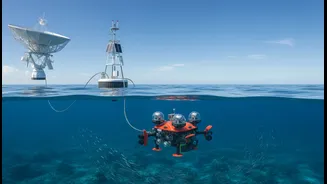
Modern disaster preparedness relies on a sophisticated network of observational tools that constantly monitor the ocean's pulse. A key component is the Argo programme, an international effort involving thousands of robotic floats that drift in the ocean. These floats dive deep to measure temperature and salinity, providing crucial data on the ocean's heat content, which is a critical factor in forecasting cyclone intensification. Another vital tool is the network of moored buoys, which collect real-time data on surface and subsurface temperatures and wind speeds. These are complemented by bottom pressure recorders and coastal tide gauges that can detect the subtle sea-level changes indicative of an approaching tsunami. This data, collected from satellites, floats, and buoys, feeds into powerful supercomputers that run complex numerical models.
From Data to Life-Saving Alerts
The raw data from these instruments is where the magic of prediction happens. At INCOIS, scientists feed this information into high-resolution models to forecast a cyclone's track, its intensity, and the potential height of a storm surge. For tsunamis, the Indian Tsunami Early Warning Centre (ITEWC), operational since 2007, integrates real-time seismic data with sea-level observations to issue alerts across the Indian Ocean region. The accuracy of these forecasts has dramatically improved. For example, improved modelling has significantly reduced the error in predicting a cyclone's landfall point, allowing for more targeted and efficient evacuations, which has helped lower the human cost of disasters. These warnings are disseminated rapidly through various channels, including SMS, radio, and dedicated apps, ensuring they reach those most at risk.
Planning for a Resilient Future
Beyond immediate warnings, ocean science is crucial for long-term coastal resilience. Advanced modelling helps create detailed coastal inundation maps, which show which areas are most likely to flood during a severe storm surge. This information is invaluable for urban planners and disaster management authorities. It guides decisions on where to build critical infrastructure like hospitals and schools, how to plan effective evacuation routes, and where to construct protective structures like sea walls or restore natural defences like mangroves. As climate change is projected to increase the frequency and intensity of extreme weather events, this long-term, science-based planning becomes more critical than ever for safeguarding India's coastal future.