



Beyond the Pink City's Walls
Jaipur's vibrant markets are a kaleidoscope of printed textiles, but the story of these fabrics doesn't begin there. To truly understand their soul, you must travel just beyond the city limits to the towns where this magic is born. A short drive takes
you to villages like Sanganer and Bagru, the twin hearts of Rajasthan's block printing tradition for over 400 years. These are not sanitized tourist displays; they are living, breathing workshops where generations of the Chhipa community have perfected their art. Sanganer, once a beneficiary of royal patronage, is known for its delicate floral motifs on bright white backgrounds. Bagru, its rustic counterpart, feels earthier, favouring bold geometric patterns and a palette drawn from nature. Driving into these towns, the scenery changes. You see vast fields where long stretches of cotton are laid out to dry under the Rajasthani sun, their surfaces covered in nascent patterns. The air itself feels different, thick with the smells of dye and wet earth.
A Symphony of Stamps and Colour
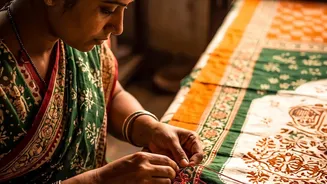
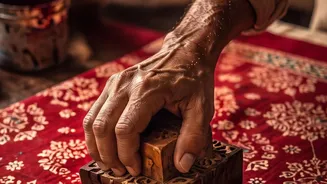
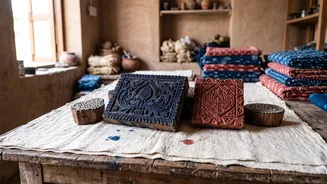
Stepping into a workshop is an immersion in sound and motion. The defining sound is the steady, percussive slam of a wooden block hitting the printing table, a rhythm that has echoed through these lanes for centuries. Artisans, known as 'chhipas', stand for hours along padded tables, working with incredible speed and precision. They dip a hand-carved teak wood block into a tray of dye, press it onto the stretched fabric, and strike it firmly with the heel of their hand to ensure a clean impression. Then, with what seems like pure muscle memory, they repeat the process, aligning the next stamp perfectly to continue the pattern. Watching them work is mesmerising. Each colour in a design requires a separate block, and the layers are built up one stamp at a time. What appears to be a single, complex pattern is actually a chorus of individual impressions, each with a slight variation in pressure or alignment that gives the final cloth its unique, man-made character.
The Magic of Natural Dyes
Much of Bagru's printing, and the older traditions of Sanganer, rely on a palette that comes directly from the earth. This is where the experience becomes truly sensory. The workshops smell of fermenting iron and jaggery, which creates a deep black dye. Indigo vats lend a sharp, distinct scent for the famous blues. Reds and corals are coaxed from the boiled roots of the madder plant, while yellows come from turmeric or pomegranate rind. One of the most fascinating processes is 'dabu', a mud-resist technique strongly associated with Bagru. A special clay paste is printed onto the fabric, which acts as a barrier. When the cloth is dipped in a dye vat, usually indigo, the areas covered by the mud resist the colour. After dyeing, the cloth is washed, the mud comes away, and the intricate pattern is revealed underneath. Seeing this organic process firsthand connects you to a cycle of craft that is inherently sustainable, using biodegradable materials and time-honoured knowledge.
A Living History Lesson
A trip to these craft towns is incomplete without a visit to the Anokhi Museum of Hand Printing, located in a beautifully restored 16th-century haveli near Amber Fort. Founded in 2005, the museum is dedicated to preserving the history and techniques of this art form. Here, the context of your workshop visits comes into full focus. Galleries display textiles, tools, and intricate wooden blocks, showcasing the evolution of different regional styles. You can see rare traditional garments and learn about the entire process, from block carving to the complex chemistry of natural dyes. The museum often has artisans on-site demonstrating their skills, allowing visitors to try their own hand at printing and truly appreciate the skill involved. It bridges the gap between the finished product you might buy in a shop and the deep cultural heritage and human effort woven into every thread.