
Seeing the Invisible with Infrared
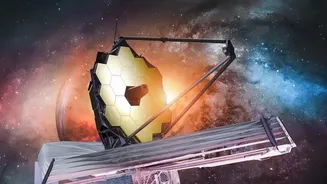
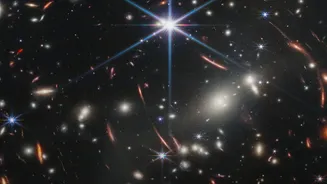
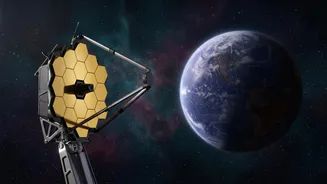
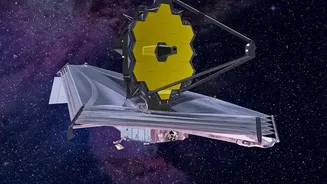
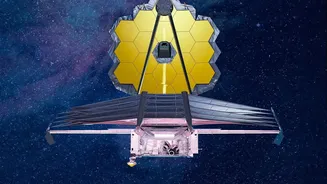
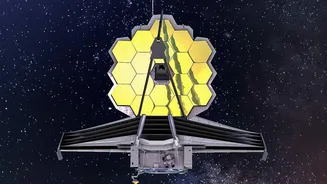
Much of the universe is hidden from our eyes, which only see a narrow band of 'visible' light. The James Webb Space Telescope is designed to see in infrared, a range of light that is invisible to humans but crucial for astronomy. Infrared light can pierce
through dense clouds of cosmic gas and dust that would otherwise obscure our view. More importantly, when it comes to studying planets, the chemical elements and compounds in their atmospheres absorb and re-emit light at specific infrared wavelengths. Each molecule, like water (H₂O) or methane (CH₄), has a unique spectral 'fingerprint'. By observing this infrared light, the telescope can identify the chemical makeup of a distant world's atmosphere, a technique known as spectroscopy.
Webb’s Specialised Infrared Instruments
To capture and analyse this faint infrared light, JWST is equipped with a suite of four powerful scientific instruments. Two are particularly vital for studying exoplanet atmospheres: the Near-Infrared Spectrograph (NIRSpec) and the Mid-Infrared Instrument (MIRI). NIRSpec covers wavelengths from 0.6 to 5.3 micrometres, while MIRI takes over from 4.9 to 28.8 micrometres. Together, they provide a comprehensive view across the infrared spectrum. To perform their function, these instruments must be kept incredibly cold—MIRI operates at a chilling minus 266 degrees Celsius—so that their own heat does not interfere with the faint signals from deep space.
Decoding an Atmosphere’s Barcode
The process of detecting water vapour relies on a method called transmission spectroscopy. When a planet passes in front of its host star from our point of view (an event called a 'transit'), a tiny fraction of the starlight filters through the planet's atmosphere. Molecules in the atmosphere absorb some of this light at very specific wavelengths. After the light passes through, the missing slivers create a unique pattern of dark lines in the star's spectrum, like a barcode. Since water vapour is known to strongly absorb particular infrared wavelengths, JWST’s spectrographs can detect its tell-tale signature in this barcode, revealing its presence even across hundreds of light-years.
Water Found in Distant Worlds
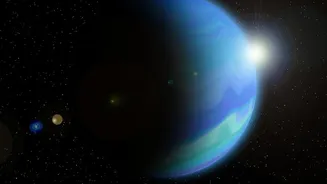
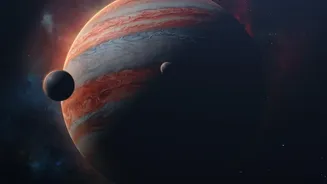
Using this very technique, JWST has already delivered groundbreaking results. It has confirmed the presence of water vapour in the atmospheres of several exoplanets. For example, observations of the hot gas giant WASP-18 b, which is ten times more massive than Jupiter, revealed subtle but clear water features despite surface temperatures reaching nearly 2,700 degrees Celsius. The telescope also detected water vapour in the fluffy, Neptune-like atmosphere of WASP-107b and the 'sub-Neptune' TOI-421 b. In a particularly exciting discovery from September 2026, Webb's MIRI instrument found water vapour within the inner, rocky-planet-forming zone of the PDS 70 system, suggesting that planets forming there have access to water from their very beginning.
Why This Search Matters
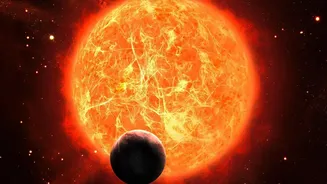
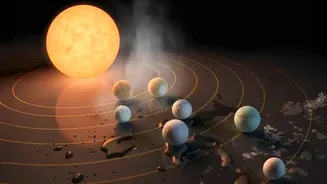
The detection of water vapour is a crucial step in the quest to find habitable worlds beyond our solar system. While finding water vapour doesn't automatically mean a planet harbours life, it is considered a fundamental prerequisite for life as we know it. These findings are helping scientists understand the diversity of planetary systems. They are also tackling key questions, like whether a rocky planet orbiting a volatile red dwarf star can form and maintain an atmosphere. Each detection of water provides another piece of the puzzle, refining our understanding of how planets form and evolve and guiding the search for worlds that might, one day, be identified as truly Earth-like.