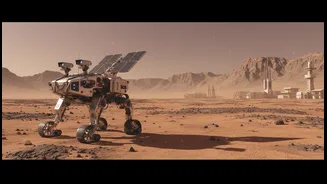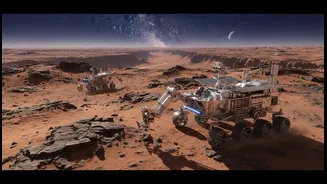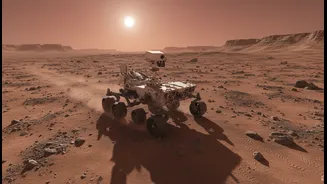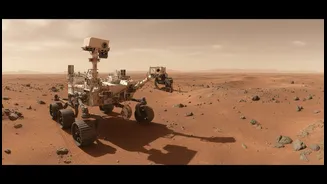




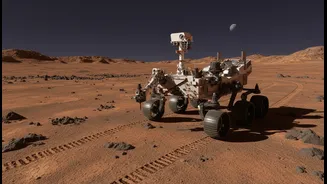


A Race Against Time and Terrain
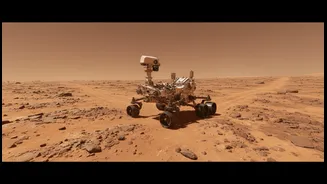
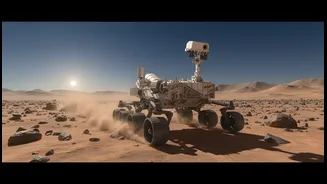
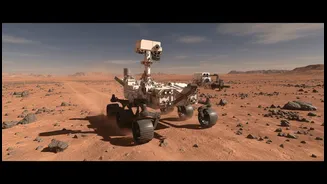
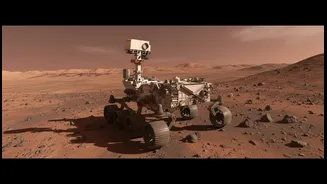
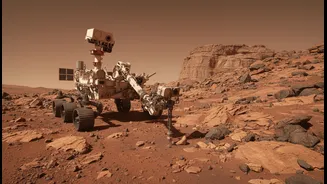
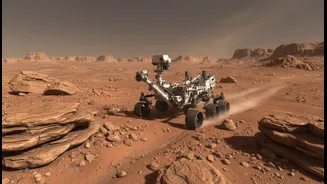
On June 14, 2026, Perseverance officially surpassed the marathon distance of 26.2 miles (42.195 kilometres). It’s only the second rover to achieve this milestone, following the legendary Opportunity rover. However, Perseverance did it in just over five
years, less than half the time it took Opportunity. This remarkable pace isn’t because Perseverance is a speed demon; its top speed is a modest 0.1 miles per hour. Instead, its efficiency comes from a powerful ability to think for itself. The journey across Jezero Crater has been anything but a smooth road race. The rover has navigated treacherous boulder fields, steep crater walls, and sandy patches that could easily trap a less sophisticated machine. Every kilometre driven is a testament to the engineering that allows it to operate millions of miles from the nearest mechanic.
The Rover That Thinks for Itself
The key to Perseverance’s record-breaking pace is its advanced autonomous navigation system, called AutoNav. While human drivers on Earth still plan the general route, they are increasingly letting the rover “take the wheel” to figure out the specifics. Using a dedicated second computer brain, Perseverance processes stereo images in real-time, creating 3D maps of the terrain ahead. Unlike its predecessor, Curiosity, which had to stop, think, and then drive, Perseverance can analyse the path and avoid hazards while still in motion. This “thinking while driving” capability allows it to cover more ground safely and efficiently, reaching up to 110 meters per hour autonomously, compared to Curiosity's 15-18 meters per hour. This leap in autonomy is crucial for exploring Mars, where the communication delay with Earth makes real-time control impossible. By making its own fine-tuned decisions, Perseverance can explore more territory and gather more science.
A Mechanic Millions of Miles Away
So what happens when a rover designed for a multi-year mission starts showing signs of wear? There are no pit stops on Mars. Every component on Perseverance was built with extreme longevity in mind, from its radiation-hardened electronics to its robust wheels. Learning from the experience of the Curiosity rover, whose wheels sustained significant damage from sharp rocks, engineers gave Perseverance thicker, more durable aluminum wheels. Mission operators also carefully manage the rover's health, monitoring everything from power levels to the torque on each wheel motor. They can even upload software updates to improve efficiency or work around problems that arise. However, the primary strategy for maintenance is preventative design. The rover is massively over-engineered with backups and redundancies, built to withstand the harsh Martian environment, including extreme temperature swings and abrasive dust, for far longer than its primary mission timeline.
Paving the Way for Future Explorers
Perseverance’s marathon is more than a symbolic achievement; it’s a critical demonstration of long-duration mobility. Every kilometre it travels proves that NASA can build robotic explorers capable of operating reliably for years on a distant world. This capability is not just about breaking records; it's a foundational requirement for future, more ambitious missions. The lessons learned from Perseverance's journey—particularly in autonomous navigation and component durability—are directly informing the design of the next generation of rovers for both Mars and the Moon. These technologies are essential for the upcoming Mars Sample Return mission, which will rely on robotic systems to collect the samples cached by Perseverance and launch them back to Earth. Ultimately, proving that a robot can safely and semi-independently navigate vast, hazardous Martian landscapes for years is a necessary step before humans can ever hope to do the same.