


A Chariot for the Sun God
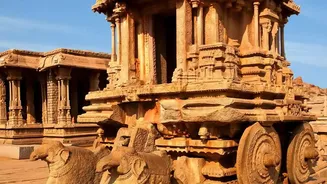
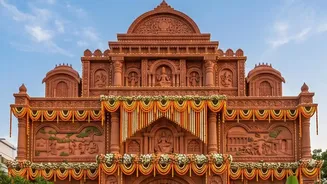
Built around 1250 CE by King Narasimhadeva I of the Eastern Ganga dynasty, the Konark Sun Temple is a monumental tribute to Surya, the Sun God. Its entire structure was conceived as a colossal chariot, appearing to carry the deity across the heavens.
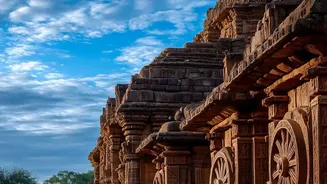
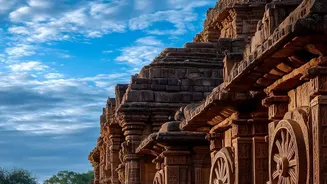
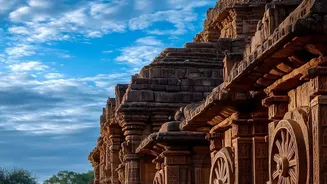
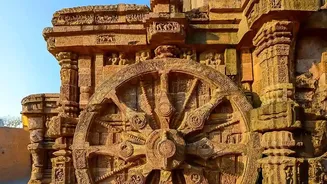
Though much of the main tower has crumbled over the centuries, what remains is breathtaking: a 100-foot-high assembly hall (jagamohana) set upon a platform with 24 intricately carved wheels, pulled by seven powerful horses. European sailors, who used its dark silhouette as a navigational landmark on the Bay of Bengal, nicknamed it the 'Black Pagoda'. The temple was engineered with astronomical precision, designed to face east so that the first rays of sunrise would strike the main entrance.
The Wheels of Time
The temple's most iconic features are its 24 massive stone wheels, each about 10 feet in diameter. These are not merely decorative. The 'main point' of the temple begins here, with the fusion of art and science. Each wheel functions as a sundial, capable of telling time with remarkable accuracy by observing the shadow cast by its spokes. The 12 wheels on each side symbolise the 12 months, and the total of 24 represents the hours in a day. The seven horses at the front represent the seven days of the week. The entire structure, therefore, is a grand, moving metaphor for time itself, governed by the celestial journey of the sun. It's a cosmic clock and a testament to the advanced astronomical knowledge of its creators.
A Stone Chronicle of Life
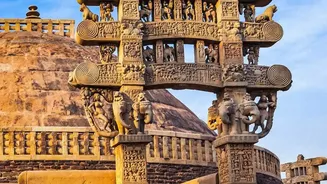
Perhaps the most important takeaway from Konark is that its carvings are not limited to the divine. The temple walls are a vibrant, detailed encyclopaedia of 13th-century Odishan life. Away from the major deities, you will find thousands of smaller sculptures depicting everyday scenes with incredible realism. There are carvings of royal processions, military marches, trade activities, musicians with their instruments, and dancers in classic Odissi poses. Animals like elephants and horses are rendered with dynamic energy, symbolizing power and strength. This makes the temple a crucial historical document, showing that worldly life and spiritual pursuits were seen as deeply intertwined. It tells the story of a society in all its complexity—its beliefs, its economy, its culture, and its people.
Understanding the Erotic Sculptures
No discussion of Konark is complete without mentioning its famous erotic sculptures. Often misunderstood, these carvings are integral to the temple's philosophical message. In ancient Indian thought, 'kama' (desire or pleasure) was considered one of the four essential goals of human life (purusharthas). The intimate figures and mithuna (amorous couples) are not placed randomly; they are part of a larger narrative about the fullness of human experience. Scholars believe these sculptures had multiple functions: representing fertility, embodying Tantric beliefs about the union of divine energies, and serving as a reminder to leave worldly desires outside before entering the inner sanctum. They reflect a time when sensuality was viewed as a natural and even divine part of the cycle of life, not as something to be hidden.
The Living Craft Tradition
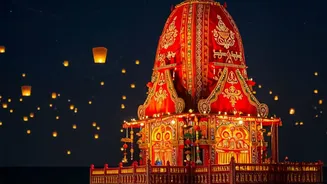
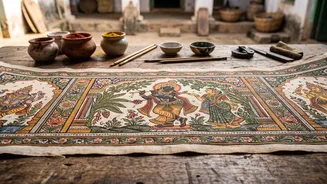
The artistic legacy of Konark's master craftsmen did not end in the 13th century. A tour of the region reveals that this creative spirit is very much alive. A short drive away are heritage craft villages like Raghurajpur and Pipili. Raghurajpur is famous for Pattachitra, a traditional form of cloth-based scroll painting where artists depict mythological tales with natural pigments. Pipili is a riot of colour, known for its intricate Appliqué work, or 'Chandua', where pieces of fabric are stitched into beautiful patterns for everything from wall hangings to temple chariots. Visiting these villages offers a direct connection to the same artistic lineage that produced the wonders of Konark, allowing you to see centuries-old techniques passed down through generations.