



A Tale of Two Faces
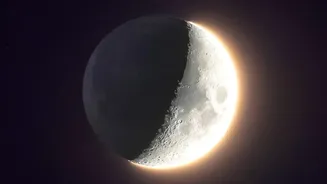
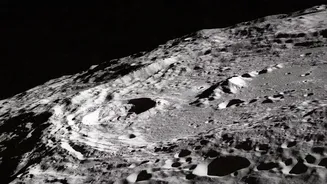
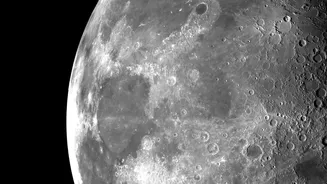
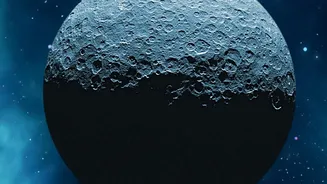
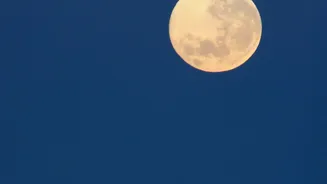
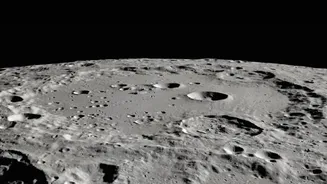
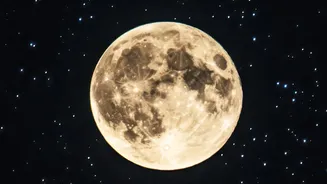
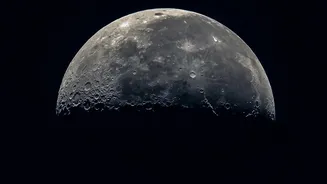
The side of the Moon facing Earth is dominated by vast, smooth, dark plains called 'maria' or seas. These are ancient volcanic basins that give the nearside its distinctive appearance. In stark contrast, the farside is almost entirely covered in rugged,
densely cratered highlands. It has a much thicker crust and very few maria. First seen by spacecraft in 1959, the farside's alien landscape presented a profound mystery: why would one celestial body have two such different faces? The answer, it seems, is rooted in the Moon's calamitous birth and its relationship with a young, scorching-hot Earth.
Forged in Cosmic Fire
The leading theory for the Moon's origin is the Giant Impact Hypothesis, which suggests a Mars-sized planet named Theia slammed into the proto-Earth billions of years ago. This cataclysmic event blasted a massive amount of molten rock and debris into orbit, which eventually coalesced to form the Moon. In the chaotic aftermath, the Moon quickly became tidally locked, meaning the same side was left to permanently face our planet. This fateful orientation set the stage for the two sides to evolve along dramatically different paths, all because of heat.
The Lingering Heat
After the giant impact, the Earth was a glowing ball of magma, radiating intense heat at temperatures up to 2,500 degrees Celsius. Because the Moon was much closer to Earth than it is today, the tidally locked nearside was relentlessly baked by this radiant heat. The farside, by contrast, was shielded from this immense furnace and cooled down much more quickly. This temperature imbalance is the critical clue to understanding everything that followed. The nearside remained molten for longer, while the farside began to solidify and build its crust.
A Thicker Skin on the Farside
As the primordial, molten Moon began to cool, certain minerals like aluminum and calcium condensed out of its vaporous atmosphere. These crust-forming elements preferentially settled and solidified on the cooler farside. This process gave the farside a head start, allowing it to accumulate a crust that is significantly thicker—by some estimates, about 20 kilometres thicker on average—than the nearside crust. The nearside, kept warm and gooey by Earth's radiant heat, simply couldn't build up its crust as quickly.
Scars of the Solar System
Later in the solar system's history, during a period called the Late Heavy Bombardment, the Moon was pelted by asteroids and comets. On the farside, the thick, robust crust largely withstood these impacts. While it became heavily cratered, the crust was too durable for most impacts to break through to the mantle below. On the nearside, however, the story was different. Its thinner crust was easily punctured by major impacts. These breaches allowed magma from the deep mantle to flood the surface, filling vast impact basins and creating the smooth, dark maria we see today.
A Mysterious Hotspot
A final piece of the puzzle lies in the nearside's unique chemical makeup. It is home to a vast region known as the Procellarum KREEP Terrane (PKT). 'KREEP' is an acronym for a geochemical mix rich in potassium (K), rare-earth elements (REE), and phosphorus (P), along with other heat-producing radioactive elements like thorium. This concentration of radioactive elements acted like a built-in heating blanket, further contributing to the mantle melting and prolonged volcanism that shaped the nearside's surface. The origin of this KREEP concentration is still debated, but its presence solidified the nearside’s distinct evolutionary path.