

A New Atlas for Lunar Water
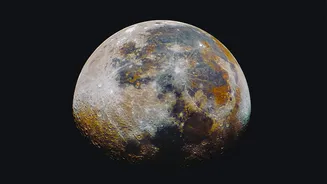
Recent analyses of data, particularly from instruments like NASA's Lunar Reconnaissance Orbiter (LRO), have provided a much clearer picture of where water ice is located. These maps focus on the Moon's south polar region, a strategic target for future
missions like NASA's Artemis program. The key areas of interest are permanently shadowed regions (PSRs) — craters and depressions that haven't seen direct sunlight in billions of years. These frigid traps are cold enough to have preserved water ice, which isn't found in vast sheets but is thought to be mixed in with the lunar soil, or regolith. While some recent findings suggest the ice may not be as widespread on the immediate surface as once hoped, the data confirms its presence and helps mission planners identify the most likely spots for extraction.
Why Water Is Lunar Gold
On Earth, water is essential for life, but in space, it is a currency of unparalleled value. For astronauts, it can provide drinking water and breathable air. However, its most significant potential lies in its chemical components: hydrogen and oxygen. When separated, these two elements are the primary ingredients for the most powerful and efficient rocket propellant. The ability to source water on the Moon and convert it into fuel is known as In-Situ Resource Utilization, or ISRU. This concept is the cornerstone of making long-term human presence in space sustainable, as it would dramatically reduce the mass and cost of missions that currently have to carry all their fuel from Earth.
From Ice to Rocket Fuel
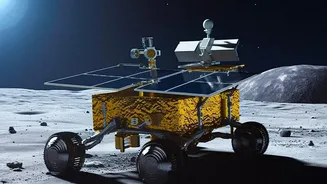
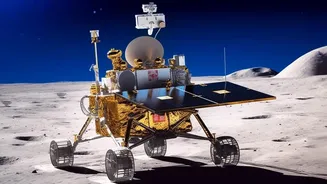
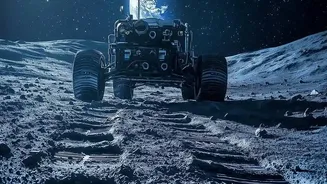
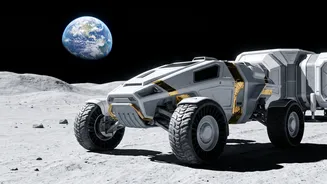
The process of turning lunar ice into fuel is a multi-step engineering challenge. First, robotic rovers would need to excavate the ice-rich regolith from the dark, extremely cold craters. This material would then be heated in a contained environment to sublimate the ice into water vapour, which is then captured and purified. The crucial step is electrolysis, where an electric current is passed through the purified water to split it into hydrogen and oxygen gases. These gases are then cryogenically cooled until they become liquids — liquid oxygen (LOX) and liquid hydrogen (LH2) — the same propellant that has powered missions for decades. Powering this entire process would likely rely on solar arrays placed on nearby crater rims that receive near-constant sunlight.
The Economics of a Lunar Gas Station
The main obstacle to deep space exploration is the immense cost of escaping Earth's gravity. A huge portion of any rocket's mass is the fuel required just to lift its own fuel into orbit. A lunar refuelling station would shatter this limitation. Rockets could launch from Earth with just enough fuel to reach the Moon, top up their tanks with locally sourced propellant, and then continue to destinations like Mars. This could reduce the cost of a Mars mission by billions of dollars. A recent report from Deloitte estimates the lunar economy could generate between $343 billion and $566 billion by 2050, with transportation being one of the largest early markets. This creates a business case not just for national space agencies but for a new ecosystem of commercial companies involved in mining, processing, and logistics.
The Next Steps on the Lunar Surface
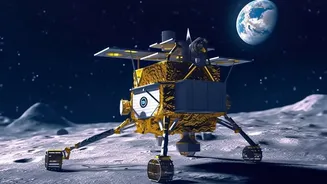
These maps are a guide, but ground-truth verification is essential. This is the goal of upcoming missions like NASA's Volatiles Investigating Polar Exploration Rover (VIPER). VIPER is designed to explore the lunar south pole, drill into the regolith, and directly measure the concentration and composition of water ice, creating the first resource maps of another celestial body. Its findings will be critical for determining the exact architecture of future mining and processing plants. Nations and private companies are in a race to develop these capabilities. India's own Chandrayaan program, which played a key role in the initial discovery of lunar water, has helped establish that these ice deposits are likely ancient and stable, boosting confidence in their potential as a resource for future human exploration.