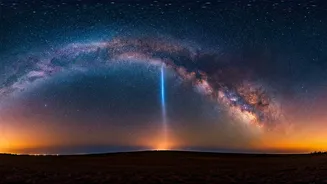




The Night Sky: Your Personal Time Machine
The concept is simple yet mind-bending. Light, while incredibly fast, takes time to travel across the vastness of space. The distance light travels in one year is called a light-year. So, when we look at a star that is 100 light-years away, we are seeing
the light that left that star 100 years ago. The star you see tonight is how it looked when your great-grandparents were young. This transforms stargazing from a simple pastime into a profound act of historical observation. You are, quite literally, seeing history unfold. The photons hitting your retina began their journey long before you were born, travelling silently through space as empires rose and fell on Earth.
Gazing at the Mughal Empire’s Sky
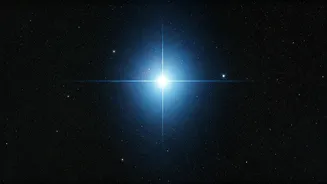
Let's make this real. Find Polaris, the North Star. It’s not the brightest star, but it’s one of the most famous. Polaris is approximately 320 to 430 light-years away. Taking a middle estimate, the light you see from Polaris tonight left its surface around the time the Mughal Empire was at its cultural zenith in India. As that specific ray of light began its cosmic voyage, Shah Jahan was commissioning the Taj Mahal in Agra, a monument to love that would become a wonder of the world. While artisans were setting marble and precious stones into place, the light from Polaris was just beginning its 400-year journey towards your eyes. When you look at it, you are sharing a sky with the architects and poets of that magnificent era.
Witness to Ancient Dynasties
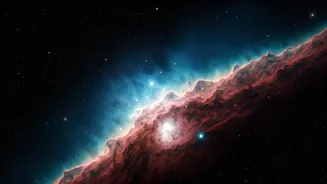
Let’s travel further back. The famous Orion Nebula, the fuzzy patch in Orion’s “sword,” is a stellar nursery where new stars are being born. The light from this beautiful cloud is about 1,344 light-years away. This means we see it as it was in the 7th century. When the light we see tonight left the nebula, the powerful Chalukya dynasty ruled over large parts of southern and central India from their capital in Badami. The great Chinese traveller Xuanzang was visiting the court of Emperor Harsha in northern India, documenting a rich and vibrant culture. The world we read about in history books was the present day for the starlight now arriving from Orion.
A Message from Before Human History
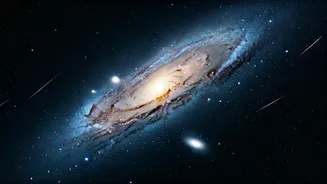
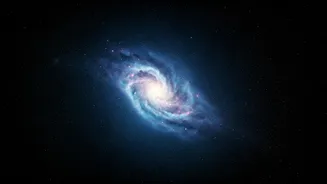
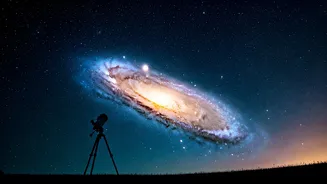
For a truly humbling perspective, you don’t even need a telescope. On a clear, dark night, far from city lights, you might be able to spot a faint, fuzzy smudge in the constellation Andromeda. This is the Andromeda Galaxy, our closest major galactic neighbour. That smudge is the combined light of a trillion stars, and it has taken 2.5 million years to reach us. When that light started its journey, modern humans did not exist. Our distant ancestors, early hominids like *Homo habilis*, were just beginning to use stone tools in Africa. The entire span of recorded human history—from ancient Sumeria to the digital age—has played out while that ancient light was already on its way. It is the oldest thing you can see with your naked eye, a ghostly message from a time before humanity itself.
How to Read This Cosmic History Book
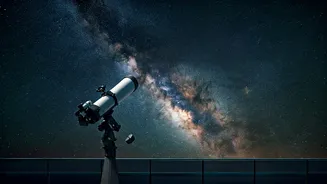
You don’t need to be an astronomer to experience this. The first step is to escape light pollution. Head to a darker area away from city glare; places like Ladakh, Spiti Valley, or even the Rann of Kutch are famous for their pristine skies. Give your eyes at least 20 minutes to fully adapt to the darkness. Use a stargazing app on your phone (with a red-light filter to preserve your night vision) to identify stars and constellations like Polaris and Orion. Even a simple pair of binoculars can reveal stunning details, like the moons of Jupiter or the hazy glow of the Orion Nebula. The key isn't expensive equipment, but a quiet moment to simply look up and appreciate the deep time hanging above you.