






A Tale of Two Skies: This Week's Planetary Show
While the headline promises a grand alignment, the reality this week is even more interesting: it’s a celestial show in two acts. The main event features Mars and Saturn, which are gathering together in the pre-dawn eastern sky. They are the stars of
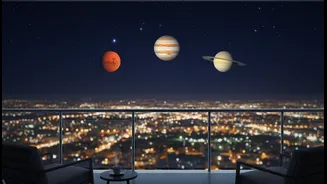
the morning. Meanwhile, the giant Jupiter makes a brief, brilliant appearance on its own in the evening sky. So, you won't see all three holding hands at once, but you can absolutely spot each of them from an urban Indian setting if you know when and where to look.
The Morning Show: Spotting Mars and Saturn
The best time for planet-spotting is in the quiet hours before sunrise. For the next several days, look towards the eastern horizon about one or two hours before the sun comes up. There you’ll find two bright, steady points of light that don’t twinkle like stars—these are Mars and Saturn. Saturn will appear as a constant, yellowish-golden dot. Mars, true to its 'Red Planet' nickname, will have a distinct reddish hue. The mornings of July 11th and 12th are particularly special, as the waning crescent Moon will join the pair, forming a beautiful celestial gathering that makes the planets even easier to locate.
An Evening Encore: A Quick Glimpse of Jupiter
Jupiter, the largest planet in our solar system, is putting on a final performance for the month in the evening sky. To catch it, you’ll need a clear view of the western horizon and perfect timing. Look for a brilliantly bright, star-like object very low in the sky shortly after sunset, as twilight deepens. Be quick, as it will dip below the horizon soon after. Its appearance this week is a fleeting farewell, as it will soon become lost in the Sun's glare before reappearing in the morning sky next month.
Your Balcony Is Your Observatory
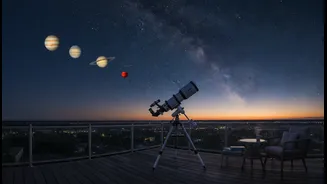
Living in a high-rise gives you a significant advantage: elevation. You are already lifted above some of the ground-level light and atmospheric haze. The key is to make the most of your vantage point. If you have access to a terrace or rooftop, that is your prime location. If you’re on a balcony, choose the side of the building that offers the clearest view of the eastern (for Mars and Saturn) or western (for Jupiter) horizon. The most crucial step is to achieve darkness. Turn off all the lights on your balcony and in the room behind you. Shield your eyes from neighbours’ lights or nearby streetlamps by positioning yourself in the shadow of a wall or pillar.
Tools of the Urban Astronomer
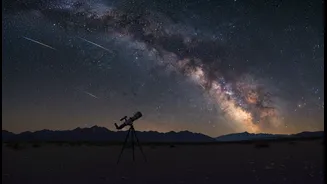
You don’t need expensive equipment for this cosmic hunt. Mars, Jupiter, and Saturn are among the five 'naked-eye planets' and are bright enough to be seen without any aid, even through the glow of city lights. However, a simple pair of binoculars will transform your experience. Through binoculars, the colours will be more vivid, and you might even be able to spot Jupiter's largest moons as tiny pinpricks of light. To remove all guesswork, use a stargazing app on your smartphone like Star Walk, Sky Map, or Stellarium. These apps use your phone’s location to create a real-time map of the sky; simply point your phone upwards, and the app will identify exactly what you're looking at.
Beating the City Glow and Haze
Light pollution is the biggest challenge for any city-based stargazer, but bright planets are the perfect targets because they can punch through the skyglow. To give yourself an edge, allow your eyes at least 20 minutes to fully adapt to the darkness—avoid looking at your bright phone screen during this time. The seeing conditions of the atmosphere also play a big role. The air is often clearer and more stable in the hours after midnight, when traffic and industrial activity lessens. A post-monsoon shower can also be a blessing, as the rain washes away dust and pollutants, leaving behind a crisper, more transparent sky for your viewing pleasure.