





The End of an Era, The Dawn of a New One
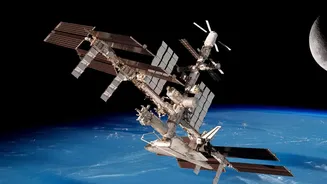
For decades, the International Space Station has been the sole hub for long-term human presence and scientific research in low-Earth orbit (LEO). However, with its planned decommissioning around 2030, NASA is transitioning from being an operator to a customer.
This strategic shift has ignited a new space race, not between nations, but between commercial enterprises. NASA's Commercial LEO Destinations (CLD) program is actively funding the development of privately owned and operated space stations to ensure there is no gap in America's presence in orbit. This move is designed to foster a robust LEO economy, where NASA is just one of many clients, purchasing services as needed.
Meet the New Players in Orbit
Several key players are at the forefront of this commercial revolution. Axiom Space is developing the Axiom Station, which will initially attach its modules to the ISS before separating to become a free-flying outpost. Blue Origin, in partnership with Sierra Space, is planning Orbital Reef, envisioned as a 'mixed-use business park' in space. Another major venture is Starlab, a joint effort by Voyager Space and Airbus, which is designed to launch on a single flight and support a wide range of research. These companies are not just building successors to the ISS; they are creating versatile platforms with different designs and business models aimed at serving a diverse clientele including space agencies, researchers, and commercial companies.
A Laboratory Unlike Any on Earth
So, how exactly will these new stations host science? The key is microgravity. The near-weightless environment of space fundamentally alters physical and biological processes. This allows scientists to study phenomena impossible to observe on Earth, where gravity's effects dominate. For example, without buoyancy and sedimentation, purer crystals can be grown for developing new drugs and semiconductors. In microgravity, the human body undergoes changes similar to accelerated aging, offering unique insights into conditions like osteoporosis and muscle atrophy. These stations are being purpose-built with dedicated laboratory modules, advanced research racks, and facilities for life sciences, materials science, and Earth observation.
Designed for Discovery and Commerce
Next-generation modules are being designed with enhanced capabilities. Starlab, for instance, will feature a large, dedicated Internal Payload Laboratory with modular platforms, high-speed data links, and specialized cooling systems to support a variety of experiments. Orbital Reef will leverage automation and robotics to reduce operational costs, making research more affordable. Axiom Space provides full-service solutions, including hardware development and mission planning, to help researchers access orbit. These stations are also designed to be more flexible, with multiple docking ports to accommodate various crew and cargo vehicles, like Sierra Space's Dream Chaser, which offers a gentle, low-g runway landing ideal for sensitive scientific samples.
Beyond the Beakers: A New Business Model
The science on these stations is enabled by a completely new commercial model. Unlike the government-funded ISS, these habitats will host a mix of users. A company could lease a module for in-space manufacturing, creating novel materials or 3D-printing biological tissues. Another might conduct pharmaceutical research, while a third could be filming a movie or hosting private astronauts. This diversified revenue stream—from research, manufacturing, and even tourism—is what makes the entire ecosystem financially sustainable. By serving a global customer base, these stations aim to create a vibrant economy in LEO, driving down costs and accelerating innovation for everyone.