

A Groundbreaking Discovery
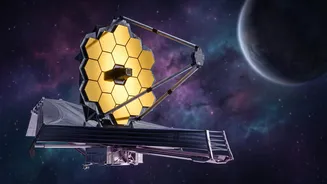
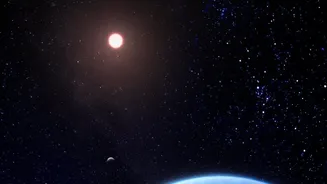
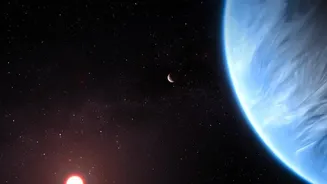
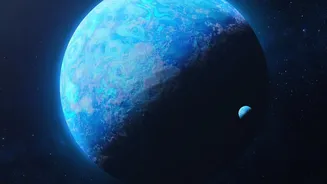
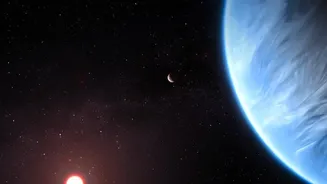
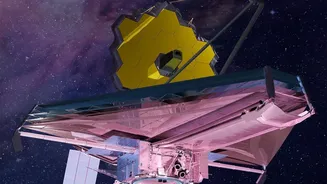
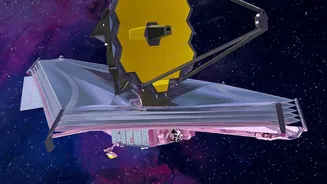
In a series of observations that have captivated the scientific community, the James Webb Space Telescope (JWST) has confirmed the presence of water vapour on multiple planets outside our solar system. One recent significant finding involves K2-18b, a planet about
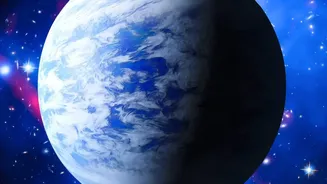
120 light-years away, where the telescope's instruments detected unmistakable signs of water in its atmosphere. This is not a vague hint, but a solid confirmation that has researchers excited about the potential for so-called 'Hycean' worlds—hot planets with vast oceans under hydrogen-rich atmospheres. Another crucial detection was made in the PDS 70 system, where water vapour was found in the inner disk where rocky, Earth-like planets are thought to be forming. This is the first time water has been spotted so close to a star in a system already known to host planets, providing a tantalizing glimpse into the conditions that might give rise to habitable worlds.
How Webb 'Sees' Alien Atmospheres
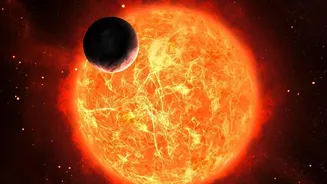
The JWST doesn't use a conventional camera to take a direct picture of these planets. Instead, it employs a technique called transit spectroscopy. As an exoplanet passes in front of its host star from our perspective, a tiny fraction of the starlight filters through the planet's atmosphere. The molecules in that atmosphere—like water vapour, methane, or carbon dioxide—absorb specific wavelengths, or colours, of light. The JWST's highly sensitive instruments, particularly its Near-Infrared Spectrograph (NIRSpec), can analyse the starlight and identify these missing slivers of the light spectrum. This creates a chemical fingerprint, a molecular and chemical portrait of a distant world's skies, revealing the composition of its atmosphere with unprecedented clarity.
The 'Mysterious' Exoplanets in Focus
The term 'mysterious' often refers to planets that have no parallel in our own solar system. Many of these recent discoveries concern 'sub-Neptunes' or 'super-Earths'—planets with sizes somewhere between Earth and Neptune. For example, K2-18b is about 2.6 times the radius of Earth. These worlds are fascinating because we have no local examples to study, making them scientific blank slates. Some, like WASP-18 b, are 'ultra-hot gas giants' that orbit incredibly close to their stars, with temperatures hot enough to tear most water molecules apart. The fact that JWST can still detect water's signature even in such extreme conditions speaks to its incredible power and sensitivity. Others, like those in the TRAPPIST-1 system, are Earth-sized and orbit in the habitable zone, making them prime candidates in the ongoing search for life.
Water Vapour: A Key Ingredient, Not a Guarantee
Finding water vapour is a monumental step, but it is not direct evidence of life or even of oceans. The presence of water is considered a key prerequisite for life as we know it, making these planets compelling targets for further study. However, a world can have water in its atmosphere without having liquid water on its surface. For example, some 'steam worlds' may have atmospheres composed almost entirely of water vapour due to extreme temperatures. The critical next step for scientists is to look for a full menu of atmospheric ingredients. This includes searching for other molecules like methane and carbon dioxide, and analyzing their ratios. Certain combinations, known as biosignatures, could point towards biological processes, but researchers are cautious. The goal is to build a complete picture of a planet's environment to assess its potential for habitability.
The Dawn of a New Era in Astronomy
Before the JWST, studying the atmospheres of smaller, rocky exoplanets was incredibly challenging, often resulting in featureless data. This powerful new telescope is changing the game, ushering in what many call a 'new era of exoplanet research'. Each discovery not only provides insights into individual planets but also helps astronomers understand the vast diversity of worlds in our galaxy and the processes that shape them. The telescope's ability to probe these distant atmospheres will allow scientists to test theories about planet formation and evolution. For example, by analyzing the atmospheric chemistry, they can infer whether a planet formed close to its star or migrated inward over time.