




An Explorer in the Great Beyond
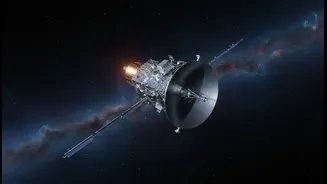
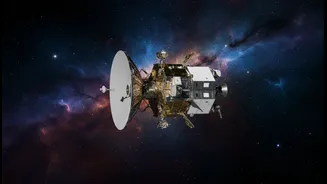
Launched in 2006, New Horizons is one of humanity's most intrepid explorers. After its stunningly successful encounter with the Pluto system in 2015, it journeyed another billion miles to study Arrokoth, the most distant object ever explored up close.
Now, nearly 6 billion miles from home, the spacecraft has transitioned into its next role. It is no longer a visitor to new worlds but a surveyor of the vast, empty-looking space that defines our solar system's edge. Its current focus is the heliosphere, the giant bubble of charged particles blown outward by our sun. This bubble acts as a crucial shield, protecting the planets, including Earth, from harsh galactic cosmic radiation.
Riding the Solar Wind
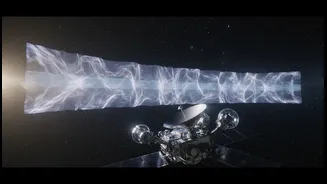
The heliosphere is created by the solar wind, a constant stream of particles flowing from the sun at about a million miles per hour. As this wind travels outward, it encounters material from the space between stars—the interstellar medium. This interaction causes the solar wind to slow down. One of New Horizons' primary jobs is to measure this deceleration with unprecedented accuracy. Using its Solar Wind Around Pluto (SWAP) instrument, scientists have found that by the time the solar wind reaches the spacecraft's current position, it has already slowed by about 13 to 15 percent compared to its speed near Earth. This gradual slowing is caused by the solar wind picking up neutral interstellar atoms, which become charged and add mass to the flow.
A Unique Vantage Point
Only two other functioning spacecraft, Voyager 1 and 2, have traveled this far out. While the Voyagers provided groundbreaking data when they crossed the heliosphere's final boundary, New Horizons has a distinct advantage. It carries more modern instruments specifically designed to study the tenuous solar wind at these extreme distances. The SWAP instrument, for instance, can make more sensitive measurements of the plasma than its predecessors could. This allows scientists to build a more detailed picture of how the sun's influence wanes with distance and to refine models of the heliosphere's shape and size. These observations provide a crucial, contemporary snapshot, complementing the data sent back by the Voyagers years ago.
Searching for the Shock
The gradual slowing of the solar wind is just a prelude to a much more dramatic event. Scientists are eagerly awaiting the moment New Horizons reaches the 'termination shock'. This is the boundary where the solar wind, after its long journey, abruptly slows from supersonic to subsonic speeds as it collides more intensely with the interstellar medium. Voyager 2 measured a sharp 46% drop in speed when it crossed this boundary. Predicting exactly when New Horizons will reach the termination shock is difficult because the heliosphere expands and contracts with the sun's 11-year activity cycle. Current estimates suggest it could happen anytime between 2029 and 2040.
Why This Cosmic Map Matters
Mapping the solar wind's boundaries isn't just an academic exercise. Understanding the structure and dynamics of our heliosphere has profound implications. This protective bubble determines how many galactic cosmic rays can penetrate our solar system, which affects radiation exposure for satellites and astronauts on deep-space missions. Furthermore, studying our own astrosphere, as these bubbles are called, gives us insight into the countless other star systems in our galaxy. It helps us understand the conditions that might make distant planets habitable by shielding them from cosmic radiation. New Horizons is not just charting the edge of our home; it's providing a guidebook for how solar systems across the universe interact with their galactic environment.