









An Epic Visual Spectacle
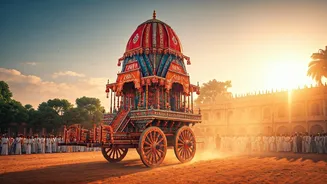
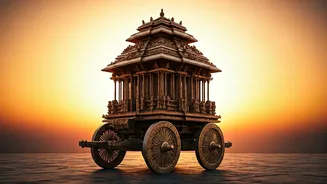
Long before Instagram and drone shots, Rath Yatra was a visual masterpiece. Three gargantuan wooden chariots, handcrafted and adorned with bright canopies, are pulled through the streets by thousands of devotees. For a generation fluent in the language
of visual media, this is not just a procession; it's unparalleled content. The sheer scale of the event—the sea of humanity, the vibrant colours against the urban landscape, the intricate details of the idols—creates a powerful, almost cinematic experience. Unlike the contained celebrations of many other festivals, Rath Yatra is a moving, breathing spectacle that unfolds in public. This 'main character energy' makes it incredibly shareable, turning every attendee with a smartphone into a documentarian of a grand, living tradition.
The Power of Participation
Gen Z values experiences over passive observation. Rath Yatra delivers this in a profound way. The central ritual involves devotees of all backgrounds pulling the massive ropes (dori) attached to the chariots of Lord Jagannath, his brother Balabhadra, and sister Subhadra. This act is seen as a deeply spiritual service, a form of direct participation available to everyone. There are no VIP sections for pulling the ropes; it is a democratising force. In an era where many experiences feel curated and exclusive, the raw, collective effort of moving these giant structures offers a sense of tangible connection and community. You are not just watching a festival; you are physically part of its momentum. This hands-on involvement fosters a feeling of ownership and shared purpose that deeply resonates with a generation seeking authenticity.
A Relatable Narrative
At its heart, the festival tells a simple, beautiful story: Lord Jagannath, accompanied by his siblings, leaves the sanctum sanctorum of his temple to visit his aunt’s home, the Gundicha Temple. This journey symbolises a deity coming out to meet the people, breaking down the barriers between the divine and the devotee. The narrative isn't about a complex theological victory or a distant mythological event; it's about a journey, a visit, a family outing on a cosmic scale. This accessible, human-centric story makes the deities feel less like remote gods and more like beloved figures on an annual holiday. For a generation that connects with storytelling and relatable characters, this narrative frame makes the entire festival more engaging and emotionally resonant.
Authenticity in a Commercialised World
While many festivals have become heavily commercialised, with sponsored events and brand integrations, Rath Yatra—especially in its traditional epicentre of Puri—retains a powerful, unvarnished authenticity. The energy is chaotic, the crowds are intense, and the devotion is palpable and raw. It’s not polished for an audience; it *is* the audience. This gritty reality is a stark contrast to the perfectly curated aesthetics often found online. For Gen Z, which has a growing appreciation for things that feel 'real' and unfiltered, the festival's organic and overwhelming nature is a significant part of its appeal. It’s a sensory overload in the best way possible, offering an experience that cannot be fully replicated or sanitised, making it a compelling escape from the hyper-curated digital world.
A Global and Local Phenomenon
Thanks to organisations like ISKCON, Rath Yatra is no longer confined to Odisha. It has become a global event, celebrated in major cities from New York to London to Sydney. This gives it a unique dual identity. It is at once a deeply rooted local tradition and a cosmopolitan festival with a global footprint. For young Indians, this duality is compelling. It connects them to a tradition that is both profoundly Indian and internationally recognised. Seeing the iconic chariots roll down a familiar city street, whether in Mumbai or Melbourne, reinforces its relevance and creates a bridge between their local identity and a global spiritual community. This mix of hyper-local devotion and global celebration makes it a cultural touchstone that feels both ancient and contemporary.