

A Personal Life-Support System
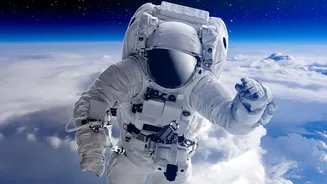
The primary job of a spacesuit, or Extravehicular Mobility Unit (EMU), is to create a livable bubble in the vacuum of space. Without it, the lack of air pressure would be instantly lethal. To counter this, the suit's inner layers form a pressurized enclosure.
A key component is the bladder layer, a rubbery, airtight material that holds in breathable air. But this balloon-like layer needs structure, which is provided by a restraint layer made of a tough fabric like Dacron. This layer prevents the suit from rigidly inflating, allowing the astronaut a crucial degree of movement.
Surviving Extreme Temperature Swings
In Earth's orbit, an astronaut experiences a sunrise and sunset roughly every 45 minutes. This causes temperatures to swing violently, from a scorching 120°C (250°F) in direct sunlight to a bone-chilling -150°C (-250°F) in the shade. To protect against this, spacesuits employ a brilliant system of insulation. The first line of defense is a Liquid Cooling and Ventilation Garment, essentially a set of long underwear woven with hundreds of feet of plastic tubing. Cool water circulates through these tubes to carry away excess body heat. The outer portion of the suit, called the Thermal Micrometeoroid Garment, contains multiple layers of aluminized Mylar—a reflective material similar to that used in emergency blankets—which insulates the astronaut, reflecting solar heat and preventing body heat from escaping.
A Shield Against Tiny Bullets
Space is not empty; it's filled with micrometeoroids and tiny pieces of orbital debris. While small, these particles travel at incredible speeds, up to 28,000 km/h, turning a grain of sand into a potentially catastrophic projectile. A puncture to the suit could lead to a fatal depressurization. The outer layers of the suit are designed as a form of cosmic body armour. The Thermal Micrometeoroid Garment's layers are built to break up and stop these high-velocity particles. The outermost shell is made of a blend of rugged, specialised fabrics, including Kevlar (the material used in bulletproof vests), Nomex (a fire-resistant material), and Gore-Tex. This tough exterior provides the final line of defense against punctures and abrasions.
Protection from Invisible Dangers
Beyond the physical threats, space is flooded with radiation from the sun and deep cosmos. Earth's atmosphere and magnetic field shield us on the ground, but in orbit, astronauts are far more exposed. While no spacesuit can completely block all radiation, its layers offer a degree of protection. The helmet's visor is particularly critical, featuring a thin coating of gold that reflects harmful ultraviolet and infrared radiation, acting like a powerful pair of sunglasses to protect the astronaut’s eyes and skin. These measures help reduce the radiation dose an astronaut receives during a spacewalk, which is crucial for their long-term health.
Completing the Personal Spaceship
Every element of the spacesuit is meticulously designed for survival and function. The helmet is a high-strength polycarbonate bubble that provides a clear view while maintaining pressure and circulating oxygen. The backpack is a self-contained life support system, housing oxygen tanks, carbon dioxide scrubbers, cooling water, and batteries. Even the gloves are a marvel, combining dexterity with layers of protection to allow astronauts to handle tools in the unforgiving environment. Together, these components form a complete, one-person vehicle, making human exploration outside the confines of a spacecraft possible.