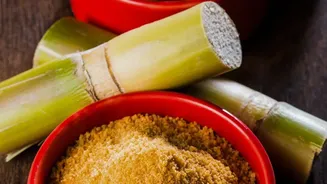









The Origin Story: Natural vs. Refined
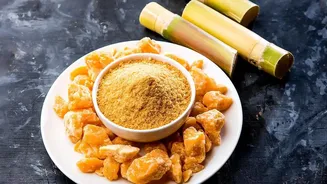
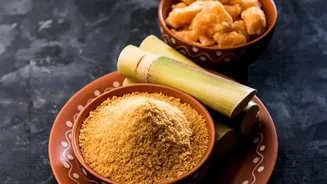
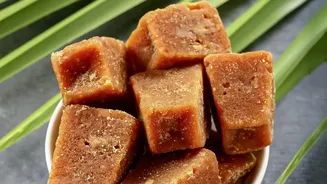
Both jaggery and white sugar originate from the same source: sugarcane juice. The crucial difference lies in the processing. To make jaggery, sugarcane juice is boiled until it thickens and solidifies. This minimal processing means it retains molasses,
the dark, syrupy part of the sugarcane that contains minerals. White sugar, on the other hand, undergoes extensive refining. The process involves crystallisation and bleaching, which strips away the molasses entirely, leaving behind pure sucrose with no other nutrients. This is why white sugar is often referred to as a source of 'empty calories'.
The Calorie Question
Here is the first surprise for many who make the switch for weight management: jaggery and white sugar have nearly identical calorie counts. A 100-gram serving of jaggery contains around 383 calories, while the same amount of white sugar has about 387 calories. This marginal difference means that replacing sugar with jaggery spoon-for-spoon will not lead to a caloric deficit or aid in weight loss. Both are energy-dense sweeteners, and from a purely caloric standpoint, neither holds a significant advantage.
Jaggery's Nutritional Edge
The primary argument for jaggery's health benefits lies in its mineral content, which is completely absent in refined sugar. Because it retains molasses, jaggery is a source of iron, potassium, magnesium, and calcium. Some of the iron content comes from being prepared in traditional iron vessels. These nutrients are vital for bodily functions, from preventing anaemia to supporting nerve function. It is also believed to have a warming effect, boost immunity, and aid digestion, making it a winter favourite in many Indian households.
The Blood Sugar Impact
This is where the 'healthy substitute' myth truly crumbles. The Glycemic Index (GI) measures how quickly a food raises blood sugar levels. Shockingly for many, sugarcane jaggery has a high GI, often reported to be around 84, which is even higher than that of white sugar (around 65). This means jaggery can cause a faster and sharper spike in blood sugar, making it an unsuitable replacement for individuals with diabetes or insulin resistance. Despite its trace minerals, the primary component of jaggery is still sucrose (65-85%), which the body breaks down into glucose quickly.
The Portion Size Reality Check
While jaggery’s mineral profile looks impressive on paper per 100 grams, the benefits diminish significantly in realistic portion sizes. A typical serving in tea or a sweet might be 10-15 grams. At this amount, the iron or magnesium you consume is a very small fraction of your daily requirement. To get a meaningful dose of these minerals from jaggery alone, you would need to consume a very large, calorie-heavy amount, where the harm from the high sugar intake would far outweigh the nutritional benefits. Therefore, while it is nutritionally superior to sugar, it should not be considered a health food or a primary source of minerals.