


Peering Back to the Dawn of Time
To see a star whose light has travelled for 12.9 billion years is to look back to a time when the universe was just 7% of its current age. At such immense distances, entire galaxies typically appear as small, blurry smudges, with the light of millions
of stars blended together. Spotting a single point of light from this era is a monumental challenge. Before these discoveries, the most distant objects seen were entire star clusters or nascent galaxies. The idea of resolving a single star from the cosmic dawn seemed impossible. The previous record, also set by Hubble in 2018, was a star whose light took 9 billion years to reach us. The latest discoveries represent a huge leap further back in time, pushing the boundaries of what we thought was observable.
Hubble's Secret: A Cosmic Magnifying Glass
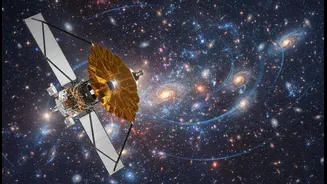
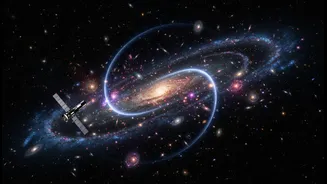
So how does a telescope launched in 1990 accomplish this feat? The answer lies not just in Hubble's remarkable optics, but in a cosmic phenomenon predicted by Albert Einstein: gravitational lensing. According to Einstein's theory of general relativity, massive objects warp the fabric of spacetime. When a massive galaxy cluster sits between us and a very distant object, its immense gravity bends and magnifies the light from behind it, acting like a natural telescope. This effect can amplify the light from a background object by thousands of times. It’s this natural magnification that allows Hubble to spot single stars that would otherwise be far too faint and distant to detect. Astronomers found the star Earendel precisely because it was perfectly aligned with a massive galaxy cluster that magnified its light.
Meet Earendel: A Glimpse of the First Stars
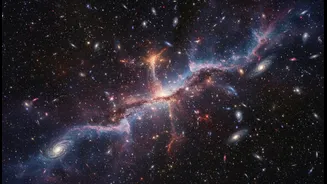
The most famous of these ancient stars is nicknamed Earendel, an Old English word for "morning star." Its light travelled for 12.9 billion years to reach Hubble's mirror. Discovered in 2022, Earendel is estimated to be at least 50 times the mass of our Sun and millions of times brighter. Even with this brilliance, it would be invisible without the gravitational lens effect. The galaxy cluster WHL0137-08, sitting between us and Earendel, distorted its home galaxy into a long crescent shape dubbed the "Sunrise Arc" and magnified the star's light by a factor of at least a thousand. Studying Earendel offers a unique opportunity to understand the very first generation of stars, which may have been composed of different raw materials than the stars we see today.
From a Single Star to a Cosmic Map
While the headline talks about "mapping" stars, the discovery of Earendel and other similar objects is more akin to finding crucial landmarks. These individual points of light provide vital data for building a larger map of the early universe. Each distant star helps astronomers test theories about the cosmos's first 900 million years. They are not creating a detailed star chart in the traditional sense, but rather piecing together the conditions of the early universe. Recent observations by Hubble have also imaged ancient globular clusters—dense collections of stars—like NGC 6426, which is estimated to be 13 billion years old. By studying both individual stars like Earendel and ancient clusters, scientists can build a more complete picture of how the first stars and galaxies formed and evolved.
Hubble's Enduring Legacy in the Webb Era
With the more powerful James Webb Space Telescope (JWST) now operational, some may wonder about Hubble's continued relevance. JWST is optimized for infrared light, which is ideal for peering even deeper into the early universe. However, the two telescopes are scientific partners, not rivals. Hubble primarily observes in visible and ultraviolet light, providing a different and complementary view. The discovery of Earendel was a prime example of this synergy; Hubble found the target, and JWST followed up with more detailed observations, confirming it is a massive B-type star about twice as hot as our sun and a million times more luminous. Hubble continues its mission, identifying targets and providing crucial data that, when combined with JWST's power, paints a more complete picture of our universe than either could alone.