


Wait, A Day Longer Than A Year?
It sounds like a riddle, but it's a simple, albeit strange, astronomical fact. For us on Earth, these two concepts are neatly separated. A day is one full rotation of our planet on its axis (about 24 hours), and a year is one full orbit around the Sun
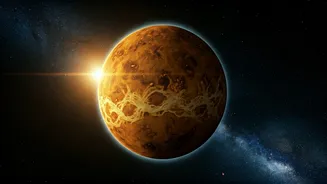
(about 365 days). On Venus, this relationship is completely upended. A single day on Venus—the time it takes for the planet to complete one full spin on its axis—is longer than the time it takes for the planet to complete an entire journey around the Sun. It’s one of the most counter-intuitive facts in our entire solar system and turns our basic understanding of time on its head.
The Bizarre Venusian Clock
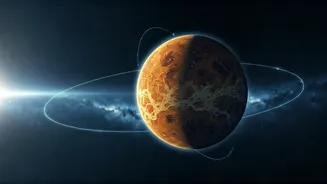
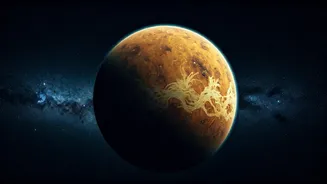
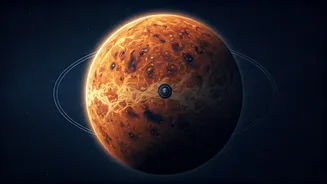
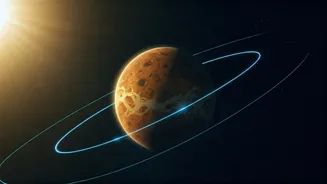
Let's break it down with Earth days as our reference. A year on Venus, its orbital period around the Sun, takes approximately 225 Earth days. This is significantly shorter than our 365-day year. Now for the mind-bending part: a single axial rotation, or a 'sidereal day,' on Venus takes a staggering 243 Earth days. That’s right. Venus takes 243 days to spin around just once, but only 225 days to go all the way around the Sun. This means that if you were standing on Venus, a full year would pass before a full day had even finished. You'd technically be a year older before the planet had even completed one rotation beneath your feet.
Venus Also Spins Backwards
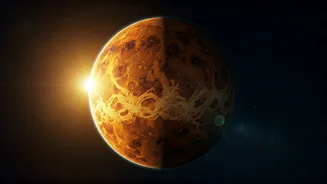
As if a day longer than its year wasn't weird enough, Venus also has what's known as retrograde rotation. It spins on its axis in the opposite direction to most other planets in the solar system, including Earth. If you could survive on its surface, you would see the Sun rise in the west and set in the east. This backward, incredibly slow spin has another strange effect. It changes the length of a 'solar day'—the time from one sunrise to the next. Because the planet is rotating backwards as it orbits the Sun, the time between sunrises is actually shorter than its full rotation period. A solar day on Venus is about 117 Earth days. So you'd have to wait nearly four months for the next sunrise!
Why is Venus So Slow and Backwards?
Scientists don't have a single, definitive answer, but there are two leading theories. The first involves a colossal impact. Early in its history, Venus may have been struck by a massive asteroid or protoplanet. Such a catastrophic collision could have been powerful enough to not only slow its rotation to a crawl but also reverse its direction entirely. The second theory points to Venus's incredibly thick and heavy atmosphere. This dense blanket of gas, about 90 times thicker than Earth's, creates immense atmospheric tides. Over billions of years, the gravitational pull of the Sun on this heavy atmosphere could have generated enough friction and torque to act as a powerful brake, slowing the planet's spin and perhaps even flipping its orientation.
A World of Extremes
This bizarre timing is just one of many extremes on Venus. Known as Earth's 'evil twin,' it has a runaway greenhouse effect that creates surface temperatures hot enough to melt lead (around 465°C). Its atmosphere is thick with carbon dioxide and clouds of sulfuric acid. The atmospheric pressure on the surface is equivalent to being nearly a kilometre deep in Earth's oceans. These hellish conditions, combined with its strange rotation, make Venus a fascinating subject of study. It serves as a cautionary tale of how a planet so similar in size to our own can evolve so differently.