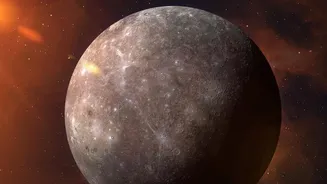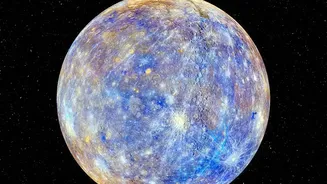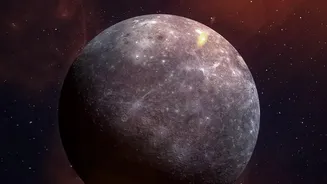







On Earth, we mark our lives by the steady rhythm of sunrises. But on Mercury, the closest planet to the Sun, this cycle is bizarrely slow. A single day, from one sunrise to the next, lasts longer than two of its years. How is this possible?
A Tale of Two 'Days'
To understand
Mercury, we first need to clarify what a 'day' is. There are two kinds. A 'sidereal day' is the time it takes for a planet to rotate once on its axis. For Mercury, this takes about 59 Earth days. But the 'solar day'—the time from sunrise to sunrise—is what we experience as a day. Because Mercury is also hurtling through space, it has to rotate a little extra after each spin to get the Sun back to the same spot in the sky. On Earth, this adds about four minutes to our 24-hour solar day. On Mercury, this difference is extreme.
A Year in Just 88 Days
Mercury is the speedster of our solar system. Being the innermost planet, it zips around the Sun in just 88 Earth days. This short, fast year is a crucial piece of the puzzle. The planet's slow rotation and its rapid orbit are in a special relationship that planetary scientists call a 'spin-orbit resonance'. Specifically, Mercury is locked in a 3:2 resonance. This means for every two trips it makes around the Sun (two Mercurian years), it rotates on its axis exactly three times. This precise cosmic timing is the foundation of its strange solar day.
The Strange Egg-Shaped Orbit
Another key factor is Mercury's orbit, which is the most eccentric, or egg-shaped, of any major planet. This means its distance from the Sun changes dramatically. At its farthest point (aphelion), it's about 70 million kilometres away, but at its closest point (perihelion), it's only 47 million kilometres away. According to the laws of orbital mechanics, this means Mercury's speed varies. It travels fastest when it's closest to the Sun and slowest when it is farthest away. This variable speed has a wild effect on how the Sun appears to move in Mercury's sky.
When the Sun Moves Backward
Here's where it all comes together. Mercury's spin speed is constant, but its orbital speed is not. When Mercury is at its fastest in its orbit—near its closest approach to the Sun—its speed through space actually outpaces its rotation speed for a short time. For an observer on the surface, this would create an incredible spectacle. The Sun, which had been slowly moving across the sky, would appear to stop, move backward for a bit, and then resume its forward path. This 'retrograde motion' of the Sun dramatically lengthens the time it takes to complete its journey from one horizon to the other.
Putting It All Together: A 176-Day Sunrise
When you combine the slow 59-day rotation, the fast 88-day year, the 3:2 spin-orbit lock, and the wonky effects of its eccentric orbit, you get the final answer. The time from one sunrise to the next on Mercury—its solar day—is approximately 176 Earth days. This means a single day on Mercury is twice as long as its year. An inhabitant of Mercury would celebrate two birthdays in the time it takes for the Sun to rise, set, and rise again just once. This unique celestial dance makes Mercury a world of incredible extremes, with scorching daylight lasting for what feels like an eternity.