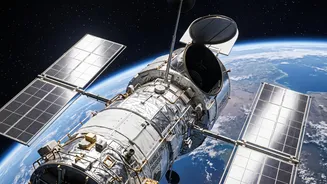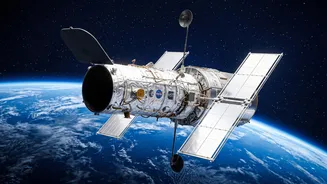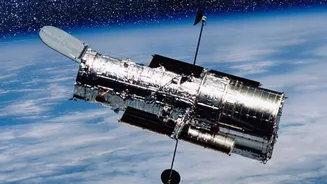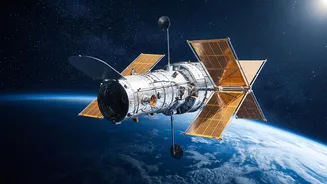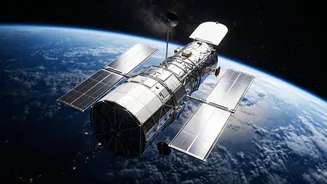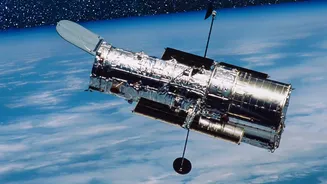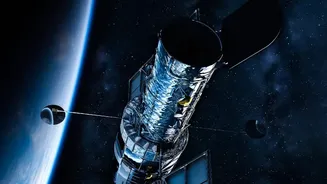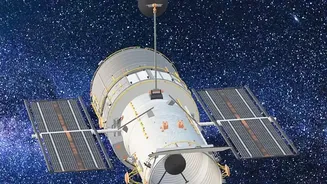






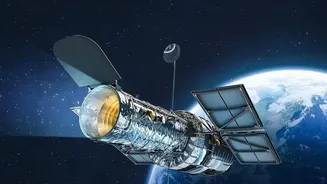
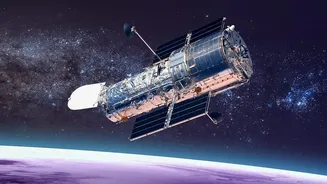
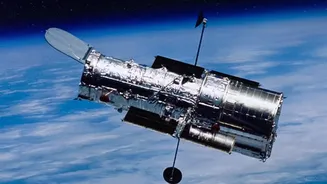
For over 35 years, the Hubble Space Telescope has been humanity’s eye on the cosmos, revolutionizing astronomy. But its orbit is decaying, and with no way to boost itself, its mission is finite. Now, NASA is turning to the commercial space industry for
a lifeline.
An Icon in Slow Decline
Since its launch in 1990, the Hubble Space Telescope has made over 1.7 million observations and contributed to thousands of scientific papers. It has helped scientists understand the accelerating expansion of the universe, peer into the atmospheres of distant planets, and capture breathtaking images of star birth and death. However, the legendary observatory is slowly falling. Like all satellites in low-Earth orbit, Hubble experiences atmospheric drag — a tiny amount of friction from the Earth's upper atmosphere that causes its altitude to gradually decrease. Currently orbiting at about 470-480 kilometers, its altitude has been steadily dropping since the last servicing mission in 2009. Without an orbital boost, NASA projects the telescope could make an uncontrolled re-entry into Earth's atmosphere between 2033 and 2034.
A Commercial Rescue Mission?
With the Space Shuttle program retired, NASA no longer has a custom-built vehicle to service Hubble. Recognizing this, the agency has formally asked the private sector for help. On October 29, 2026, NASA issued a Request for Information (RFI), asking commercial space companies for innovative ideas to prolong Hubble's life. This isn't a formal contract but a market survey to gauge what's possible. The RFI outlines three potential missions: boost Hubble to a higher, more stable orbit of at least 600 kilometers; service the telescope to enhance its capabilities; or perform a controlled de-orbit to ensure it re-enters the atmosphere safely over an uninhabited part of the ocean. Companies have until November 30, 2026, to submit their concepts, which would need to be executed by 2032.
The Potential Saviors
This isn't the first time a commercial Hubble mission has been floated. In 2022, NASA and SpaceX signed an agreement to study the feasibility of using a Dragon spacecraft to reboost the telescope, a concept pushed by the Polaris Program, a private mission series funded by billionaire and now-NASA Administrator Jared Isaacman. While NASA didn't pursue that specific plan at the time, the new RFI opens the door for SpaceX and others to present updated or entirely new robotic concepts. The commercial in-space servicing market has grown significantly, with companies like Northrop Grumman and startups such as Astroscale developing technologies for docking with and maneuvering satellites. The RFI is a major signal that could anchor a new commercial market for satellite life extension.
More Than Just a Boost
Saving Hubble is about more than preserving a single, iconic telescope. A successful commercial servicing mission would be a landmark achievement, proving that private companies can perform complex operations on legacy satellites that were never designed for such interactions. This could unlock a new frontier for the space industry, creating business opportunities in satellite repair, refueling, relocation, and debris removal. Pushing Hubble to a higher orbit could extend its scientific life by 15 to 25 years, allowing it to continue its work alongside newer observatories like the James Webb and Nancy Grace Roman space telescopes. It would ensure that Hubble’s unique capabilities in ultraviolet and visible light astronomy remain available to scientists well into the next decade.