



The Dark Side of the Universe
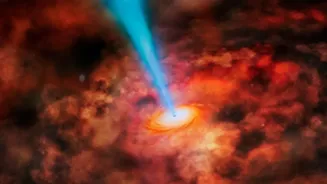
For decades, scientists have treated dark matter and dark energy as two separate, albeit equally baffling, problems. Dark matter is the invisible 'scaffolding' of the universe. We can't see it, but we know it's there because of its gravitational pull
on stars and galaxies. Without it, galaxies would simply fly apart. It acts as the cosmic glue holding everything together, yet its true nature remains one of the most significant unsolved puzzles in physics. On the other hand, dark energy is the mysterious force that is causing the expansion of the universe to speed up. Instead of gravity pulling everything back together, some unknown pressure is pushing everything apart at an ever-increasing rate. This discovery was so revolutionary it earned a Nobel Prize, but it left scientists with an even bigger question: what is this energy and where does it come from?
A Unified Cosmic Theory
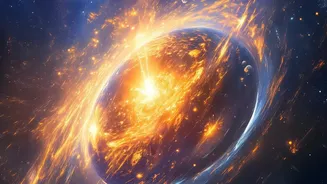
The standard model of cosmology, known as Lambda-CDM, assumes these two 'dark' components do not interact. They coexist but live separate lives. However, a wave of new research is challenging this long-held assumption. Scientists are now testing a tantalising possibility: what if dark matter and dark energy are not separate phenomena at all? What if they are two sides of the same coin, linked by a single, underlying physical principle? This line of inquiry suggests that a unified 'dark fluid' could be responsible for both the gravitational clustering we attribute to dark matter and the accelerating expansion we attribute to dark energy. The idea is that this fluid behaves differently at different scales. In the dense environments of galaxies, it clumps together and acts like matter. In the vast, empty voids of space, its properties change, and it exerts a negative pressure, pushing the universe apart.
What the New Research Suggests
Recent studies, leveraging powerful new observatories, are putting this theory to the test. One compelling model being explored is the idea of 'interacting dark energy'. In this scenario, dark matter particles are not entirely stable. Over cosmic timescales, they may slowly decay, transforming their energy into the force we call dark energy. This would mean the amount of dark matter in the universe is slowly decreasing, while the amount of dark energy is increasing, which could explain why the cosmic expansion began to accelerate relatively late in the universe's history. Researchers are running complex simulations to see if this model matches the actual structure of the cosmos we observe today. By comparing the predictions of these new theories with precise data on galaxy distribution and the cosmic microwave background—the faint afterglow of the Big Bang—scientists can look for subtle clues that favour one model over another.
Searching for Answers in the Stars
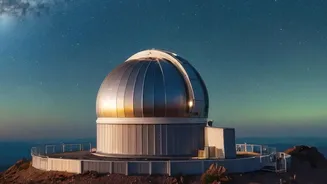
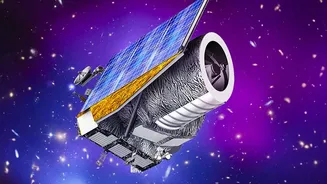
The proof, as always, is in the observations. Telescopes like the Euclid space telescope and the James Webb Space Telescope are providing an unprecedentedly clear view of the distant universe. They are creating vast 3D maps of galaxy positions and measuring how the light from ancient galaxies has been stretched and bent by gravity on its journey to us. These measurements are incredibly sensitive to the push and pull of dark energy and dark matter. If dark matter and dark energy do interact, this should leave a subtle but detectable signature in the way galaxies are clustered across the cosmos. For example, if dark matter is 'leaking' energy to the dark energy field, it could slightly alter the growth of large-scale structures. Finding such a deviation from the standard model would be a watershed moment in science, opening a new window into the fundamental laws of physics.