


How to Sail on Sunshine
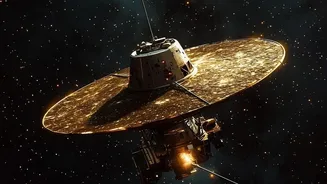
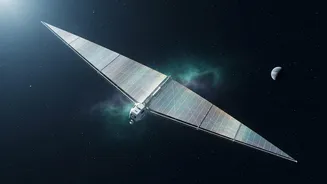
A solar sail functions much like a ship's sail, but instead of catching wind, it catches sunlight. Light is made of particles called photons, which have no mass but carry momentum. When these photons bounce off a large, reflective, ultra-thin sheet, they
transfer that momentum, giving the spacecraft a tiny but continuous push. Unlike chemical rockets that provide powerful but short bursts of thrust, a solar sail offers a gentle, unending acceleration. Because it doesn’t require heavy fuel, a solar sail can, over time, achieve incredible speeds, making it an ideal technology for long journeys across the vast emptiness of space.
From Theory to Successful Test Flights
The idea of solar sailing has been around for over a century, but turning it into a working technology has been a gradual process. Early missions proved the concept was possible. Japan’s IKAROS spacecraft successfully demonstrated solar sailing during a fly-by of Venus in 2010. More recently, The Planetary Society’s crowdfunded LightSail 2 mission, which ended in 2022, showed that a small satellite could use sunlight to actively change its orbit around Earth. These missions were crucial stepping stones, building confidence and providing data for the next generation of more ambitious solar sail spacecraft.
The ACS3 Breakthrough
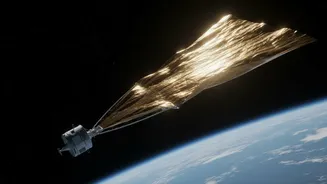
The latest leap forward comes from NASA's Advanced Composite Solar Sail System, or ACS3. Launched in April 2024, the mission's primary goal was to test new, lightweight composite booms designed to unfurl and support a large sail. These new booms are a critical innovation, as future sails will need to be massive—some as large as a basketball court or bigger—to generate meaningful thrust for deep-space missions. In August 2024, the ACS3 spacecraft successfully deployed its 80-square-meter sail, about the size of a small apartment. Mission operators are now testing the maneuvering capabilities of the sail, with the goal of demonstrating controlled changes in the spacecraft's orbit powered only by sunlight. This demonstration is vital for proving the reliability and control needed for complex missions.
The Deep-Space Advantage
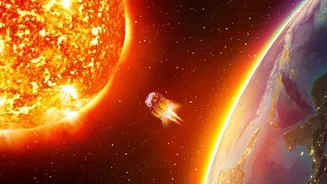
The true promise of solar sails lies in their potential for exploring the outer solar system and beyond. For missions to distant planets or even interstellar space, conventional rockets are limited by the amount of fuel they can carry. Solar sails eliminate that constraint. This propellant-less propulsion enables long-duration, low-cost missions. Scientists envision using solar sails for a variety of tasks, from providing early warnings for solar storms by placing satellites closer to the Sun, to conducting reconnaissance of near-Earth asteroids. Some concepts, known as Extreme Solar Sailing, involve using a close fly-by of the Sun to achieve incredible velocities, potentially cutting travel time to the outer planets from years down to months.
The Next Generation of Starships
The success of ACS3 is already paving the way for even larger and more capable systems. NASA and its commercial partners are designing sails with areas 20 times larger than that of ACS3. In April 2026, a $10.2 million contract was awarded to Opterus to develop the deployment system for a 1,600-square-meter sail, with delivery planned for 2028. Another project, Solar Cruiser, aims to launch in 2025 to demonstrate a sail's ability to maintain a position that would be impossible with conventional propulsion. These technologies are not just for probes; the lightweight composite boom material being tested could one day be used to frame habitats on the Moon and Mars.