



The Overcast Challenge
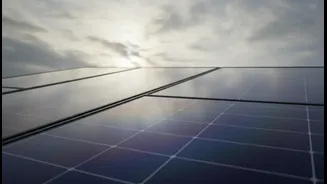
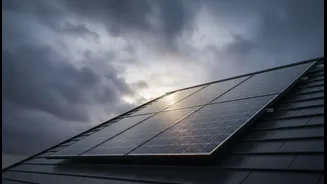
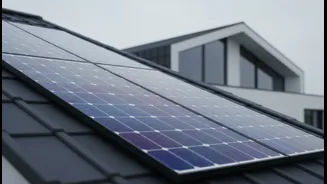
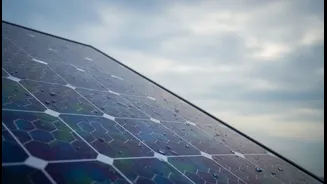
Conventional solar panels work by converting sunlight into electricity, but their performance drops significantly when clouds roll in. On a heavily overcast day, a standard solar array might only produce 10% to 25% of its rated capacity. This is because
panels rely on both direct sunlight and what's known as diffuse light—sunlight that is scattered by clouds and particles in the atmosphere. While they can use this scattered light, traditional silicon-based cells are far more efficient under a clear, direct sun. This limitation has been a major hurdle for solar adoption in regions with frequent cloudy weather, such as parts of Europe or areas in India during the monsoon season, making energy generation inconsistent and less predictable.
Meet the Game-Changer: Perovskites
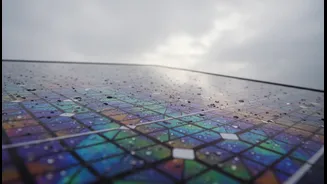
Enter perovskites. This isn't a brand name, but a class of materials defined by their unique crystal structure. First discovered decades ago, their potential for solar energy has only been realised in the last fifteen years, with efficiency levels skyrocketing in a fraction of the time it took for traditional silicon cells. What makes perovskites so special is their incredible ability to absorb light. They are particularly effective in low-light conditions, making them ideal for harvesting energy on cloudy days or even from indoor lighting. Some studies suggest they can be twice as efficient as conventional cells in low light. Furthermore, the materials are inexpensive and can be 'tuned' to capture specific colours, or wavelengths, of light.
A 'Tag Team' Approach to Efficiency
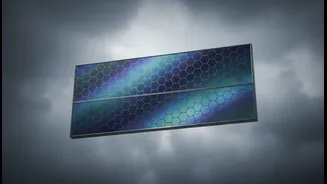
The most exciting development is not just using perovskites alone, but pairing them with traditional silicon in what are called 'tandem solar cells'. Think of it as a two-stage filter for sunlight. A thin, semi-transparent layer of perovskite is placed on top of a silicon cell. The perovskite layer is tuned to capture high-energy light, like blue and green photons. Any light it doesn't absorb—primarily lower-energy red and infrared light—passes straight through to the silicon layer below, which is perfectly suited to capture it. By working together, this 'tag team' wastes far less of the solar spectrum, dramatically boosting overall efficiency. While top-tier silicon panels max out around 23-24% efficiency, tandem cells are already breaking the 34% barrier in lab settings and being commercialised.
More Than Just a Panel
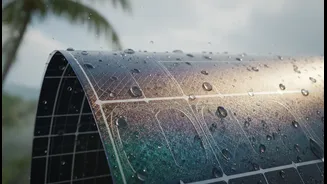
The term 'solar sheets' in the headline points to another key advantage: versatility. Perovskite solar cells can be manufactured as ultra-thin, lightweight, and even flexible films. This opens up a world of possibilities beyond rigid, heavy rooftop panels. Imagine windows that generate electricity while remaining largely transparent, or car roofs and building facades seamlessly integrated with solar-capturing surfaces. Researchers have already developed solar cells that are nearly 70% transparent by designing them to absorb mainly invisible infrared light. These thin-film applications mean solar energy could soon be harvested from almost any surface without compromising aesthetics or function.
From the Lab to the Grid
This technology is moving rapidly from research to reality. Companies in the UK and China are already shipping early versions of these tandem panels for use in larger solar farms. For instance, UK-based Oxford PV has delivered its first commercial-scale tandem panels, while Chinese manufacturer LONGi holds efficiency world records. However, there are still challenges to overcome. The primary hurdle is durability; early perovskite cells tended to degrade more quickly than silicon, especially when exposed to moisture and heat. Researchers are actively working on new chemical formulations and protective layers to extend their lifespan to the 25-plus years expected of conventional panels. As these issues are resolved, large-scale manufacturing is expected to ramp up, driving down costs.