



A Ghost in the Machine
By re-examining decades-old data from NASA's Hubble Space Telescope, a team of astronomers led by the University of Warwick has uncovered a tantalizing mystery. Orbiting a white dwarf star named HS 0209+0832, located 270 light-years away, there are signs
of a Jupiter-sized planet. But it's not the planet itself that's unusual; it's the star's strange diet. White dwarfs are known for pulling in and consuming nearby debris, which leaves a chemical fingerprint in their atmosphere. Instead of the usual rocky elements like silicon and iron, HS 0209+0832 is accreting bizarrely high levels of heavy elements like zinc, copper, and especially niobium — an element never before seen in a white dwarf's atmosphere and found at levels 1,000 times higher than in our Sun. This strange chemical signature has led scientists to a startling hypothesis.
What is a White Dwarf?
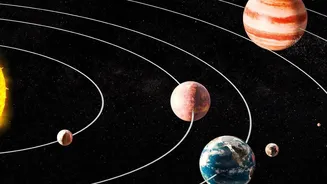
To understand the significance of the discovery, you first need to know what a white dwarf is. When a star similar in size to our own Sun runs out of hydrogen fuel, it begins a dramatic end-of-life sequence. It swells into a red giant, a phase where it will likely engulf and destroy its inner planets — a fate that awaits Mercury, Venus, and possibly Earth in several billion years. After this violent expansion, the star sheds its outer layers, leaving behind a tiny, incredibly dense, and hot core: a white dwarf. Think of it as the cooling corpse of a once-mighty star. These stellar remnants are common, and studying them gives us a glimpse into the future of most star systems, including our own.
The Second-Generation Puzzle
Planets that survive a star's red giant phase are called 'first-generation' survivors. Astronomers have found a few of these hardy worlds orbiting distant white dwarfs. But the chemical evidence at HS 0209+0832 doesn't fit a surviving planet. The high levels of niobium are a tell-tale sign of nuclear reactions that only happen deep inside a star during its death throes. This suggests the material falling onto the white dwarf isn't from an old, surviving planet, but from something new, formed from the very ashes the star expelled as it died. This is the definition of a 'second-generation' planet. It's a world born not alongside its star, but from its remains, long after its death.
Forged in Stellar Fire
How could such a planet be reborn? The leading theory is that as the star was dying, it expelled its outer layers, which were rich in newly forged heavy elements. Ordinarily, this material would disperse into space. However, scientists speculate that a nearby companion star could have corralled this material into a flat, rotating disk around the newly formed white dwarf. Within this 'second-generation' protoplanetary disk, the dust and gas could have clumped together over millions of years, eventually forming a new, giant planet. Data from NASA's TESS satellite adds another piece to the puzzle, showing a faint, repeating brightness signal every 4.4 days, consistent with a Jupiter-sized planet orbiting the white dwarf very closely and having its atmosphere slowly stripped away by the star's intense radiation. This stripped material would then fall onto the star, explaining the strange chemical signature Hubble detected.
Why This Discovery Matters
Confirming a second-generation planet around a white dwarf would be a landmark discovery. It suggests that planetary formation isn't a one-time event that only happens around young stars. Instead, it could be a cyclical process. This opens up fascinating possibilities. White dwarfs cool down very slowly, meaning a planet in a stable orbit could remain in the star's habitable zone for billions of years, far longer than Earth has been habitable. This discovery implies that even after a star has died, its system could see a new chapter, with new worlds and perhaps, new possibilities for life to emerge. It transforms the epilogue of a star's life into the potential beginning of a new story.