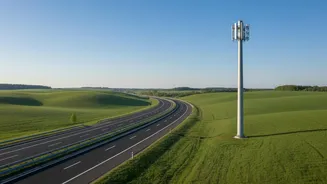







Defining the 'Travel Corridor'
In the simplest terms, 'travel corridors' are the major arteries of the nation's transport network. This includes critical national highways and high-traffic railway routes that millions of people use daily. For years, the quality of the mobile network in a fixed
location, like your home or office, has been the primary focus. However, as our work and lives become more mobile, seamless connectivity on the go is no longer a luxury but a necessity. TRAI's recent initiative acknowledges this shift by specifically targeting the user experience while in transit, marking a significant change in how network quality is evaluated. The regulator is now conducting extensive independent drive tests (IDTs) on routes like the Ahmedabad to Gandhidham rail line and highways connecting major cities.
TRAI's New Quality of Service Mandate
The telecom regulator has initiated a series of independent drive tests across the country, from highways in Jammu and Kashmir to railway routes in Gujarat and Bihar. These tests are designed to capture a real-world picture of the services provided by telecom operators like Airtel, Jio, BSNL, and Vodafone Idea. TRAI's teams are actively measuring a range of performance indicators to assess the 'Quality of Service' (QoS). This isn't just about whether you can make a call; it's a far more granular assessment looking at call drop rates, call setup success, and crucially, data performance. The findings from these tests are shared with the service providers, pushing them to take corrective action where deficiencies are found.
Why Data Speed Is the New King
While call drops are a known annoyance, TRAI's current assessments place a heavy emphasis on data throughput—that is, download and upload speeds. This focus reflects the evolution of mobile phone usage. Today, a journey often involves video conferencing for work, streaming media for entertainment, or using data-intensive navigation apps. A network that only supports basic calling is no longer sufficient. The performance metrics now being scrutinised include not just average download speeds, but also latency, jitter, and packet drop rates, which directly impact the quality of real-time applications like video calls and online gaming. For instance, recent tests on the Ahmedabad-Gandhidham rail route measured average 5G/4G download speeds ranging from 64 Mbps to over 134 Mbps depending on the provider, showcasing the kind of high-performance data delivery TRAI wants to see consistently.
The Measurement Methodology
To ensure objectivity, TRAI uses its appointed agencies to conduct these drive tests under supervision. The process involves vehicles and personnel equipped with specialised equipment that continuously test the networks of all major operators simultaneously along a predefined route. The tests use SIM cards for all providers, initiating live voice calls and data sessions across 2G, 3G, 4G, and 5G networks. This allows for a direct, side-by-side comparison of performance in the exact same location and time. Furthermore, TRAI has revamped its 'MyCall' app, empowering consumers to provide real-time feedback on their call quality, which supplements the technical data gathered during drive tests and helps create a holistic view of the customer's Quality of Experience (QoE).
Impact on Telcos and Consumers
For telecom operators, this heightened scrutiny means they can no longer afford to have coverage gaps along major transport routes. The public release of these test results creates competitive pressure, as no company wants to be seen as the provider with the poorest network on a popular highway or railway line. This is expected to drive investment in network densification and optimisation outside of major urban centres. For consumers, the ultimate goal of TRAI's initiative is a more reliable and consistent mobile experience during travel. It aims to reduce the frequency of dropped connections, buffering videos, and failed uploads. As these standards are enforced, travellers can look forward to a future where their journey from one city to another doesn't mean entering a digital dead zone.