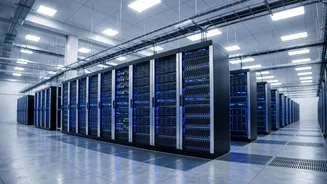







India's digital infrastructure is set for an unprecedented boom. A new forecast from Crisil predicts the nation's data centre capacity will surge five-fold by 2030, an expansion fueled almost entirely by the voracious computing needs of AI.
A Five-Fold Expansion on the Horizon
According to
a recent report from Crisil Ratings, India's installed data centre capacity is projected to skyrocket to approximately 7.5 gigawatts (GW) by March 2030. This represents a five-fold increase from the current base and is expected to attract investments of more than ₹3 lakh crore. This surge is not just about adding more storage; it's a fundamental shift in the scale and power of the nation's digital backbone, transforming it into an investment super-cycle. The growth is primarily propelled by the exponential rise of generative artificial intelligence (GenAI), coupled with ongoing enterprise digitalisation and ever-increasing data consumption by over a billion internet users.
The AI and GenAI Catalyst
While India's digital growth has been steady for years, the advent of AI has lit a fire under the data centre market. Unlike traditional enterprise applications, AI and GenAI workloads require immense computational power to train complex models and process vast datasets. This translates to a need for data centres with higher power densities, advanced cooling solutions, and infrastructure specifically designed for GPU-intensive tasks. Crisil notes that the compute-intensive nature of GenAI workloads is a primary driver for hyperscalers—large cloud service providers like Amazon, Microsoft, and Google—to secure massive capacity in advance, providing revenue certainty for developers. This AI-specific demand is expected to account for a rapidly growing share of all new capacity.
The Bedrock of a Digital Economy
The expansion goes beyond just serving AI. It is a critical enabler for the entire digital economy. Factors like the mass adoption of 5G, the proliferation of Internet of Things (IoT) devices, surging use of OTT streaming platforms, and government policies promoting data localisation all contribute to the rising demand. Data localisation rules, which mandate that certain types of data be stored within India's borders, have made domestic data centres essential infrastructure for both local and global companies operating in the country. This foundational growth, which accelerated after the pandemic, has created a high-demand environment where existing data centres are already operating at nearly 90% utilisation.
Power, Land, and Water: The Key Challenges
A fivefold expansion, however, is not without significant hurdles. The single biggest challenge is power. Data centres are incredibly energyintensive, and the new generation of AIready facilities requires even more. Crisil highlights that nearly threefourths of the upcoming capacity is concentrated in a few key hubs like Mumbai, Hyderabad, and Visakhapatnam. In these cities, the projected data centre load could equal a substantial portion of their current peak electricity demand, making timely grid connectivity and transmission upgrades critical. Beyond power, securing large tracts of land and managing the immense water required for cooling systems present further obstacles that could lead to delays and cost overruns if not managed proactively.
India's Competitive Edge
Despite the challenges, India holds several key advantages that make it an attractive global data centre destination. Development costs—including land, construction, and labour—are roughly 20% lower than in competing Asia Pacific markets. This, combined with comparatively lower power tariffs, allows Indian data centres to offer rental rates that are 30–35% cheaper than their peers. Furthermore, the ability to develop large campuses powered by renewable energy aligns perfectly with the sustainability goals of global hyperscalers, who are the biggest customers for this new capacity. This combination of cost effectiveness and a commitment to green energy is positioning India as a strategic hub for the future of AI infrastructure, even attracting international clients whose workloads serve markets outside of India.