


More Than Just Walking
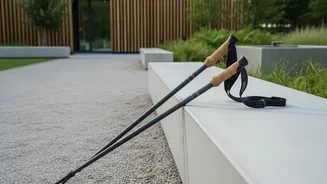
So, what exactly sets Nordic Walking apart from a regular walk? The difference lies in the specially designed poles. Unlike trekking poles used for stability on hikes, Nordic poles are used to propel you forward. With every step, you plant the pole and
push off, engaging not just your legs but your entire upper body. This technique mimics the motion of cross-country skiing and is the secret to turning a simple walk into a comprehensive workout. It effectively activates the muscles in your arms, shoulders, chest, and core, something a normal walk just can’t do.
The Full-Body Fitness Advantage
The results of this full-body engagement are impressive. Studies and experts note that Nordic Walking can engage up to 90% of your body's muscles, compared to about 50% with regular walking. This increased muscle activation means you burn more calories—some estimates suggest an increase of 20% to 46%—without necessarily feeling like you're working harder. It’s a low-impact exercise, making it gentle on the joints, which is great news for those with knee or back concerns. The poles also provide extra stability, improving balance and posture as you walk.
The Philosophy of Gradual Training
The beauty of Nordic Walking lies in its adaptability, which is where "gradual training" comes in. This isn't about pushing yourself to the limit from day one. Instead, it’s a sustainable approach focused on slow, steady progress. The core idea is to start with what feels comfortable and build from there. If you're new, you might begin by using the poles for just a portion of your walk, focusing purely on getting the technique right. As your confidence and coordination grow, you can gradually increase the duration of your walks, the frequency per week, or the intensity by incorporating hills or picking up the pace.
Your First Steps to Getting Started
Ready to give it a try? The first step is getting the right gear—specifically, a pair of Nordic Walking poles, which have a special strap system. Once you have your poles, focus on the basic technique. The fundamental movement is coordinating your opposite arm and leg. As your left leg steps forward, your right arm swings forward to plant the pole, and vice versa. The motion should feel natural. Stand tall, keep your shoulders relaxed, and plant the poles at an angle behind you, pushing off to propel yourself forward. Many beginners find it helpful to simply drag the poles at first to get a feel for the rhythm before adding the push.
A Sample Four-Week Progression
A structured but flexible plan can make all the difference. In your first week, aim for three 20-minute walks, focusing only on technique and maintaining a comfortable pace. In week two, you could increase this to 25 or 30 minutes, three to four times a week, starting to apply more pressure through the poles. By week three, as the motion becomes more fluid, you might walk for 30 minutes, four times a week, and begin to experiment with a slightly brisker pace. In week four, you could extend your walks to 40 minutes and perhaps introduce a gentle incline to increase the challenge. The key is to listen to your body and progress at a pace that feels right for you.