

Peering Through the Dust
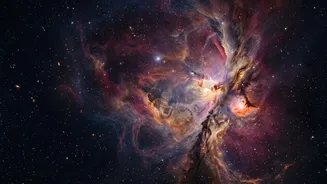
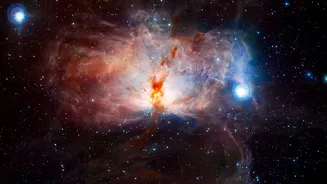
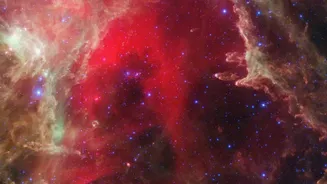
For centuries, stellar nurseries were largely hidden from us, shrouded by the very dust and gas that fuels them. These colossal clouds block visible light, making it nearly impossible for telescopes like Hubble to see the infant stars forming deep within.
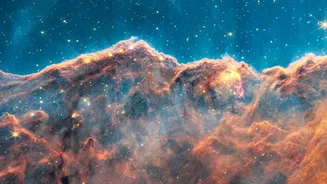
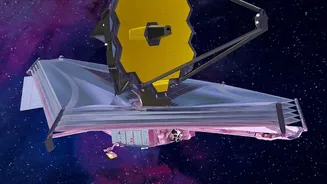
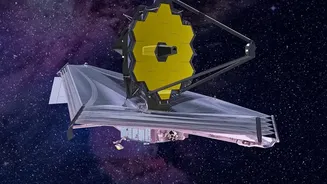
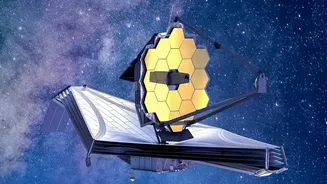
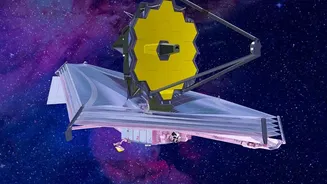
This is where the James Webb Space Telescope's magic comes in. By observing the universe in infrared light, Webb can pierce through these dense cosmic blankets. This unique capability has allowed astronomers to witness the earliest, most elusive stages of star formation in breathtaking detail, revealing objects and processes that were previously only theoretical. Regions like the Carina Nebula and the Tarantula Nebula are now being seen with astonishing clarity, showing us the chaotic and beautiful environments where stars ignite.
What is a Stellar Nursery?
Think of a stellar nursery as a cosmic maternity ward. It's an immense interstellar cloud of cold, dense gas (mostly hydrogen) and dust. Within these clouds, gravity begins to pull material together into dense clumps. As a clump gets more massive, its core gets hotter and more compressed, forming what is known as a protostar. This is the embryonic stage of a star. A protostar isn't yet a true star because it’s not hot enough for nuclear fusion—the process that powers stars like our Sun—to begin in its core. For thousands or even millions of years, the protostar will continue to gather mass from a surrounding disk of gas and dust. Recent Webb observations have given us incredible images of these protoplanetary disks, which are the very places where future planets will form.
Jets, Outflows, and the Birth of a Star
The birth of a star is anything but peaceful. As the young protostar spins and pulls in material from its surrounding disk, it also blasts out powerful jets of gas from its poles. These jets, travelling at incredible speeds, slam into the surrounding cloud, creating glowing shockwaves. Webb has been instrumental in detecting these jets and outflows from very young stars, some of which were completely hidden before. In one region known as the Cosmic Cliffs within the Carina Nebula, scientists used Webb to identify dozens of previously unknown outflows, providing a snapshot of this fleeting but crucial phase of stellar development. These observations help astronomers understand how a star stops growing by clearing away the leftover material, a critical step that influences the final mass of the star and the formation of any planets around it.
Building Blocks of Planets and Life
One of the most exciting aspects of studying stellar nurseries is understanding the origins of planets. The same disk of gas and dust that feeds the central protostar is also where planets are born. Webb's powerful instruments can analyze the chemical composition of these disks, identifying water ice and complex organic molecules. These are the fundamental building blocks for both rocky planets like Earth and potentially for life itself. In one observation of a young protostar, Webb found evidence of silicates—minerals that are common on Earth—forming in the hot inner disk before being transported to the colder outer regions where comets form. This helps explain how materials created in fiery conditions end up in the frozen comets at the edge of our own solar system.