


A Postcard from the Past
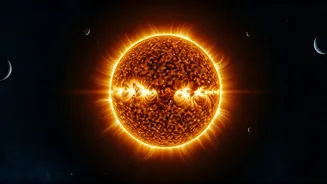
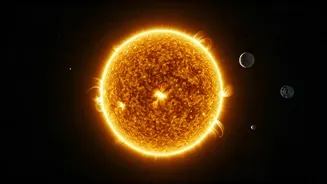
Every point of light in the night sky is a time capsule. The farther away an object is, the older the light we receive from it. The light from our own Sun takes about eight minutes to reach Earth. The light from Proxima Centauri, the nearest star, takes over
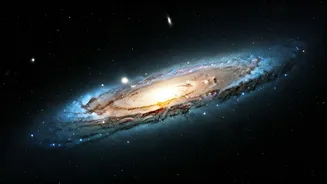
four years. And the light from the centre of our own Milky Way galaxy? That takes roughly 26,000 years to cross the vast expanse of space to reach our telescopes. This fundamental principle of physics turns astronomy into a form of cosmic archaeology. Astronomers aren't just observing what’s happening now; they are piecing together the history of the universe by studying ancient light. This headline refers to one of the most fascinating examples of this: seeing the echoes of an event that happened in our galaxy’s past, long before we had the technology to witness it directly.
Our Galaxy’s Sleeping Giant
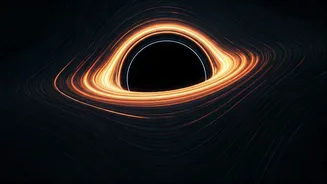
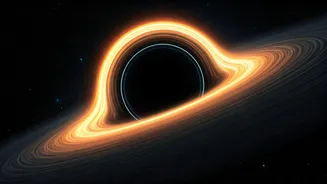
At the heart of the Milky Way, there is a supermassive black hole known as Sagittarius A* (pronounced 'Sagittarius A-star'). It's a true behemoth, containing the mass of four million Suns packed into an incredibly dense point. For most of modern human history, Sagittarius A* has been relatively quiet—a sleeping giant. It occasionally nibbles on nearby gas and dust, producing faint flickers, but it's far from the ravenous monsters we see at the centres of more active galaxies. However, scientists have long suspected it wasn't always this peaceful. Evidence suggested that Sagittarius A* has had a more violent and active past. The question was, how could they prove it? They couldn’t travel back in time, but they could look for the leftover evidence of its past outbursts.
Echoes of a Cosmic Roar
This is where the "rays" come in. In a landmark discovery, astronomers found evidence of a powerful flare that erupted from Sagittarius A* about 200 years ago, around the turn of the 19th century. The original flash of light from this event has long since passed us by. So how do we know it happened? The answer lies in 'light echoes'. Imagine shouting in a large canyon. You hear your voice, and then a moment later, you hear echoes as the sound bounces off the canyon walls. The X-rays and gamma rays from the black hole’s eruption acted like a cosmic shout. As this intense burst of radiation travelled outwards, it slammed into massive clouds of interstellar gas floating thousands of light-years away from the galactic centre. When the radiation hit the gas, it caused the clouds to light up, or fluoresce, much like a fluorescent light bulb. It is this reflected light—the echo—that our modern X-ray telescopes like NASA's Chandra X-ray Observatory can see today.
Playing Cosmic Detective
By studying these illuminated gas clouds, astronomers could piece together the story. They could measure how bright the reflected light was, which told them how powerful the original explosion must have been. The answer: it was about a million times brighter than the current energy output of Sagittarius A*. This was no small flicker; it was a cataclysmic event. Even more cleverly, they could date the event. By measuring the distance between the reflecting gas cloud and the black hole, and knowing the speed of light, they could calculate backwards to determine when the original burst of light must have left the black hole to arrive at the cloud at the right time for us to see it today. The timeline pointed directly to an event that took place approximately two centuries ago, when empires were rising and falling on Earth, completely unaware of the colossal explosion unfolding in their own galactic backyard.
Why This Ancient History Matters
This discovery reshapes our understanding of our own galaxy. It proves that the tranquil heart of the Milky Way is capable of dramatic, violent outbursts. Our 'sleeping giant' was once a roaring monster, and it could be again. Understanding the cycle of activity for supermassive black holes is crucial for understanding how galaxies form and evolve. These findings provide a unique benchmark for astronomers. By knowing what our own galaxy's black hole is capable of, they can better interpret what they see in other, more distant galaxies. It's a reminder that the universe is not a static, unchanging backdrop. It is a dynamic, evolving place, and we are just now beginning to read the pages of its vast history.