



A Tale of Two Galaxies
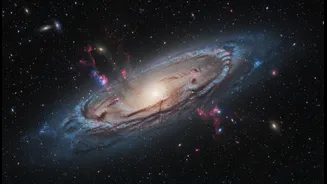
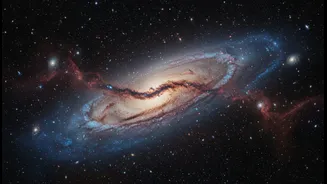
At first glance, Centaurus A is a striking celestial object. It appears as a giant, glowing orb of stars sliced in half by a dark, thick band of cosmic dust. This peculiar appearance is not a design flaw but a scar from a violent past. Astronomers have
determined that Centaurus A is the product of a galactic merger—a slow-motion crash between a large elliptical galaxy and a smaller spiral galaxy that began hundreds of millions of years ago. The dramatic dust lane is the mangled, warped remnant of the spiral galaxy, its gas and dust now churning within the larger galaxy's gravitational pull. This collision triggered a firestorm of star birth, with clusters of young, brilliant blue stars tracing the edges of the dust lane. Because it’s one of the closest and clearest examples of this process, it serves as an invaluable laboratory for understanding how such cosmic collisions reshape the universe.
The Monster in the Middle
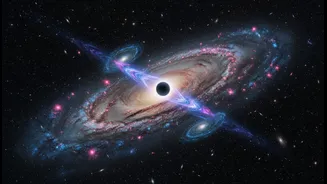
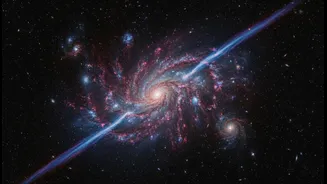
At the heart of this cosmic crime scene lies an even more powerful engine of chaos: a supermassive black hole around 55 million times more massive than our Sun. Unlike the dormant black hole at the centre of our own Milky Way, the one in Centaurus A is active. It is furiously feeding on a steady diet of gas and dust from the galactic merger. As material swirls into the black hole, it unleashes incomprehensible amounts of energy, launching two colossal jets of high-energy particles in opposite directions. These jets travel at nearly half the speed of light and extend for over a million light-years, far beyond the visible confines of the galaxy itself. These powerful outflows slam into the surrounding gas, creating shockwaves that can both trigger the birth of new stars by compressing gas clouds and blast away the material needed for star formation, making the black hole both a creator and a destroyer.
Webb's Unrivalled Infrared Vision
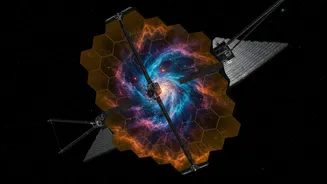
For decades, the very feature that makes Centaurus A so visually stunning—its thick belt of dust—has also been a source of frustration for astronomers. Visible-light telescopes like the Hubble Space Telescope struggle to see past this opaque screen to the galaxy's core. While previous infrared observatories like the Spitzer Space Telescope could peer through the dust, they lacked the sharpness to resolve fine details. This is where the James Webb Space Telescope (JWST) has become a game-changer. Webb is designed to see the universe in infrared light with unprecedented clarity. Its powerful instruments, MIRI and NIRCam, can cut through the obscuring dust and resolve millions of individual stars within the galaxy's chaotic heart. For the first time, scientists can see the intricate filaments, glowing clouds of warm dust, and even mysterious S-shaped structures hidden within the core.
Answering Astronomy's Biggest Questions
With its new, crystal-clear view, the JWST is allowing scientists to tackle fundamental questions about how galaxies evolve. By distinguishing between different generations of stars, astronomers can build a more precise timeline of Centaurus A's history, mapping out which stars existed before the merger and which were born from the ensuing chaos. This helps them understand the complex feedback loop between a supermassive black hole and its host galaxy. They can directly observe how the black hole's jets and radiation influence star formation across the galaxy. The latest images, released in July 2026 to celebrate Webb's fourth year of operations, have provided the most detailed view yet, showing gas moving rapidly under the black hole's influence. Centaurus A is no longer just a beautiful, peculiar object; it's a dynamic laboratory for watching the universe’s most extreme processes unfold in real time.