





A Cosmic Needle in a Haystack
The first major hurdle is the sheer scale of the search. The solar system is vast, and the number of near-Earth objects (NEOs) is immense. Current estimates suggest there are about 25,000 NEOs larger than 140 meters—the size considered a significant regional
threat—and more than half remain undiscovered. Below that size, the numbers multiply into the millions. Spotting these objects involves telescopes repeatedly imaging sections of the night sky, looking for faint specks of light that move against the fixed background of stars. It's an astronomical game of spot-the-difference, where the targets are often tiny, dark, and millions of kilometers away.
The Challenge of 'Small' and 'Dark'
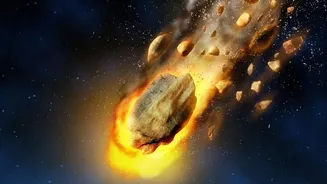
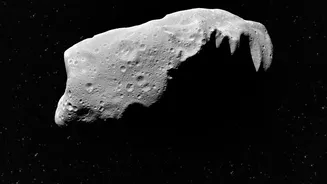
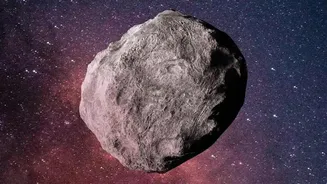
What astronomers consider a "small" asteroid can still be the size of a multi-story building, capable of unleashing an airburst with the energy of a nuclear weapon, as seen over Chelyabinsk, Russia, in 2013. These objects are incredibly difficult to detect because they reflect very little sunlight. An asteroid’s brightness in visible light depends on both its size and its albedo, or surface reflectivity. A large, dark asteroid can appear as faint as a small, reflective one, making size estimation tricky. Many asteroids are darker than anticipated, composed of materials that absorb most of the light that hits them, rendering them nearly invisible to all but the most sensitive surveys.
The Sun's Blinding Glare
One of the most significant limitations of current detection methods is a massive blind spot: the area of the sky near the Sun. Ground-based telescopes can only operate at night, looking away from the Sun. This means any asteroid approaching Earth from the sunward direction is effectively cloaked in daylight. This was the case with the Chelyabinsk meteor, which arrived undetected from the direction of the morning sun. This blind spot can hide not only small rocks but also much larger objects until they are dangerously close. A whole class of asteroids, known as Atiras, orbit entirely within Earth's path, making them exceptionally difficult to track from the ground.
Speed, Trajectory, and Location
The physics of the search presents further problems. Telescopes on the ground are hampered by weather, daylight, and atmospheric distortion. Furthermore, most major survey telescopes are in the Northern Hemisphere, creating a hemispherical bias in our sky coverage. Asteroids that move very fast across the sky can be missed by survey software, which often requires multiple detections over a period to confirm an object and calculate its orbit. Conversely, very slow-moving objects can be mistaken for stationary background noise. Highly elliptical or inclined orbits can also mean an asteroid only rarely comes into a detectable position, giving astronomers a very short window to spot it.
The Next Generation of Asteroid Hunters
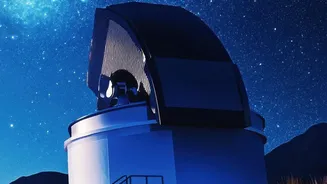
Recognizing these limitations, scientists are developing new tools to close the gaps. The Vera C. Rubin Observatory, expected to begin its full survey soon, will scan the entire southern sky every few nights with unprecedented sensitivity. It is projected to discover millions of new asteroids, drastically increasing our catalog of potentially hazardous objects. To tackle the sunward blind spot, NASA is developing the NEO Surveyor, a space-based infrared telescope scheduled to launch by 2028. By operating in space at the L1 Lagrange point, it can look back toward Earth's orbit and detect asteroids by their heat signature, regardless of how dark they are. This mission is specifically designed to meet the goal of finding 90% of NEOs larger than 140 meters.