





After staring into the cosmos for 94 nights, a revolutionary Canadian telescope has captured a faint whisper from the distant past. This isn't just any signal; it's the elusive glow of hydrogen from when the universe was less than half its current age.
The Telescope That Listens
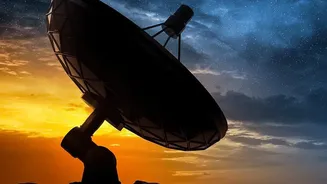
The instrument at the heart of this discovery is the Canadian Hydrogen Intensity Mapping Experiment, or CHIME. Located in British Columbia, it looks less like a traditional satellite dish and more like a set of enormous metal half-pipes. Unlike telescopes that move to track objects, CHIME is stationary, surveying a vast portion of the northern sky every single day as the Earth turns. Its purpose is not to take beautiful pictures of individual stars, but to measure the faint radio emissions from vast clouds of hydrogen gas, the most common element and the raw material for all stars and galaxies. By mapping this hydrogen, CHIME can chart the large-scale structure of the universe across billions of years.
A Signal from the Cosmic Past
The signal CHIME detected is known to astronomers as the '21-centimeter line'. It's a specific radio frequency emitted by neutral hydrogen atoms when the spin of their electron flips relative to their proton. This emission is incredibly faint, but because hydrogen was so abundant in the early universe, it acts as a cosmic tracer. Since the light from this signal has been travelling for billions of years, detecting it today is like looking back in time. The signal captured by CHIME comes from a period when the universe was only about five billion years old, offering a snapshot of a much younger cosmos.
The Needle in a Cosmic Haystack
Finding this ancient signal was an immense technical challenge. The 21-centimeter line is incredibly weak and easily drowned out by much louder radio noise from sources in our own galaxy, human technology like radio broadcasts, and even the telescope's own instruments. To isolate the signal, researchers had to develop new data-processing techniques. They analyzed data from 94 separate nights of observation in 2019, painstakingly filtering out the foreground noise. After more than a year of rigorous testing to ensure it wasn't a false alarm, the team confirmed they had successfully detected the genuine glow of hydrogen from the distant universe.
A New Way to Map the Universe
What makes this achievement a milestone is that CHIME detected the signal using only its own data. Previously, similar experiments had to cross-reference their findings with galaxy surveys from other optical telescopes to confirm a detection. This new result proves that 'intensity mapping'—measuring the combined glow of hydrogen over vast areas—is a viable technique on its own. This makes the process of studying the early universe faster and significantly less expensive, opening a new, independent pathway for cosmological research. It's a major proof of concept for the telescope, which was specifically designed for this kind of measurement.
Probing the Mystery of Dark Energy
By successfully mapping the distribution of hydrogen, CHIME can give us a new tool to investigate one of the biggest mysteries in physics: dark energy. This unknown force is believed to be causing the expansion of the universe to accelerate. By creating a 3D map of how matter was clustered at different points in cosmic history, scientists can measure the expansion rate of the universe over time. This data will allow them to test competing theories about the nature of dark energy and see if its influence has changed over billions of years. This detection is the first step toward creating those comprehensive cosmic maps.