

A Monument to an Empire
The story of the Victoria Memorial begins with the death of Queen Victoria in 1901. Lord Curzon, the Viceroy of India at the time, proposed the creation of a grand memorial to honour the long-reigning monarch. His vision was not just for a static monument,
but for a living institution that would serve as a museum and gallery, chronicling the story of the British in India. The foundation stone was laid in 1906 by the Prince of Wales, who would later become King George V. Construction took 15 years, with the memorial officially opening to the public in 1921. By then, the capital of British India had already shifted to Delhi, leaving this grand structure as a magnificent relic of a bygone era in a city that was once the empire's epicentre.
Indo-Saracenic Grandeur
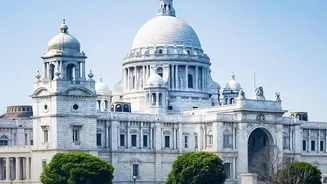
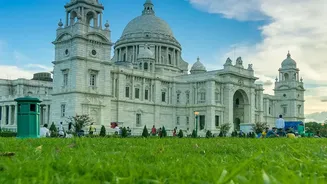
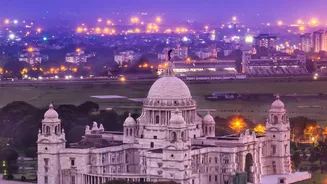
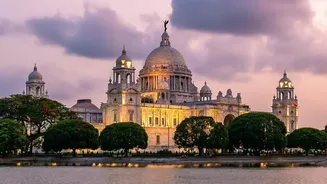
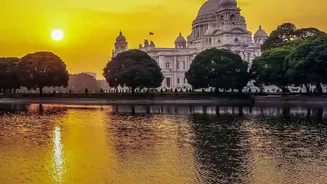
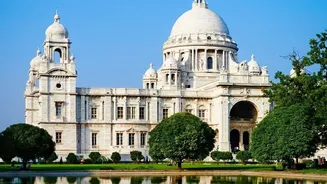
The architect, William Emerson, was tasked with creating a structure that was both imposing and elegant. He masterfully blended European and Mughal architectural styles, resulting in a stunning example of the Indo-Saracenic revivalist style. The building's gleaming facade is made entirely of white Makrana marble, the very same stone used in the construction of the Taj Mahal, to which it is often compared. The design consciously echoes the Taj with its large central dome, four smaller subsidiary domes, high portals, and domed corner towers. This fusion creates a unique visual identity, where Italian-style statues and Venetian elements coexist with distinctly Mughal 'chhatris' (domed pavilions), making it a captivating subject for any architecture enthusiast.
The Angel of Victory and Other Treasures
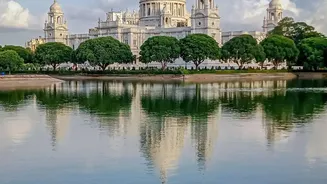
Crowning the central dome, 56 metres above the ground, is the iconic 'Angel of Victory'. This nearly 5-metre tall bronze statue was crafted in Italy and can rotate with the wind, acting as a weather vane. The dome is also surrounded by allegorical sculptures representing concepts like Art, Architecture, Justice, and Charity. The sprawling grounds, covering 64 acres, are as much a part of the experience as the building itself. Designed by Lord Redesdale and David Prain, the gardens feature manicured lawns, serene water bodies, and numerous statues of key figures from the British Raj, including a prominent bronze statue of Queen Victoria on her throne.
Inside the Hallowed Halls
The memorial's interior was envisioned as a national gallery, and today it functions as a museum under the Ministry of Culture. It houses 25 galleries with an extensive collection of artefacts from the colonial period and beyond. The Royal Gallery contains paintings depicting scenes from Queen Victoria's life and reign, alongside her childhood pianoforte and writing desk from Windsor Castle. The Calcutta Gallery traces the history of the city itself, from its origins to its time as the capital. Visitors can also find collections of arms and armour, rare books and manuscripts, and paintings by European artists like Thomas and William Daniell. After India's independence, the museum also incorporated artefacts related to the freedom movement, adding another layer to its historical narrative.
Visiting This Living Landmark
Today, the Victoria Memorial is more than just a historical monument; it is a vibrant cultural hub for Kolkatans and a must-see for travellers. The gardens are open daily and are a popular spot for morning walks and quiet contemplation. The museum itself is open from Tuesday to Sunday. Reaching the memorial is easy, with Maidan being the nearest metro station. While planning your visit, remember that separate tickets are required for the gardens and the museum, though a museum ticket includes garden entry. It offers a perfect blend of history, art, and nature, making it an unmissable part of any Kolkata itinerary.