

A New Member of the Uranian Family
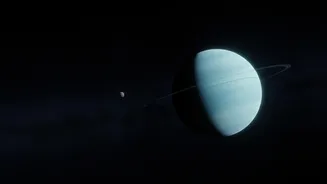
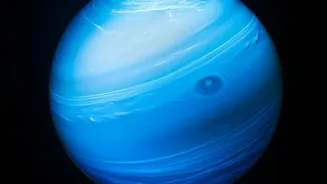
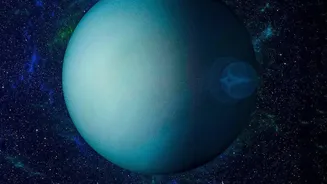
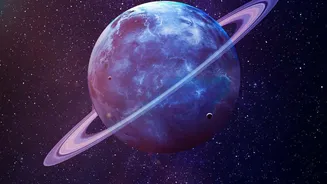
Announced in February 2024, the new moon, provisionally named S/2023 U1, is a faint, tiny object, estimated to be only about 8 kilometres in diameter. It is now the 28th known moon of Uranus. This is the first new Uranian satellite found using ground-based
telescopes in more than 20 years, a significant achievement for planetary scientists. The moon follows a long, 680-day orbit far from the planet, categorising it as an 'irregular' moon, likely captured by Uranus's gravity long ago rather than forming alongside the planet. Following tradition for Uranian moons, it will eventually be named after a character from a Shakespeare play.
The Needle in a Cosmic Haystack
Finding a world as small as S/2023 U1 is an immense challenge. At a distance of nearly 3 billion kilometres from Earth, Uranus and its surroundings are incredibly difficult to observe in detail. The planet's own brightness can easily wash out the faint light reflected by a tiny, dark object orbiting it. The discovery was made by astronomer Scott S. Sheppard using the powerful Magellan telescopes in Chile. It required a special technique of taking many long-exposure images and then digitally stacking them, aligning them to Uranus's motion. This process allows faint objects moving with the planet to emerge as points of light while background stars streak past. Sheppard described the discovery as one of the faintest ever found around the ice giant planets with ground-based telescopes.
The Ghostly Dance of Orbital Mechanics
Simply spotting the moon once isn't enough; confirming its existence and mapping its orbit is the real puzzle. To prove that S/2023 U1 was truly a moon and not a passing asteroid, astronomers had to find it again. After the initial sighting in November 2023, Sheppard and his colleagues calculated a potential orbit. Armed with this prediction, they were able to search through archival images and found the moon in data from as far back as 2021, which had been taken with both the Magellan and Subaru telescopes. Connecting these dots across several years of observations allowed them to definitively map its long, elliptical path around Uranus, a process that requires meticulous calculation and collaboration with orbit specialists at NASA's Jet Propulsion Laboratory.
Why These Tiny Worlds Matter
The study of irregular moons like S/2023 U1 offers a unique window into the past. Their distant, strange orbits are relics of the solar system's chaotic early history. Scientists believe these moons are fragments of larger bodies that were captured by the planet's gravity and then shattered by collisions with comets or asteroids. By studying their orbital families, or groups of moons with similar paths, researchers can piece together the story of these ancient collisions. The new moon appears to belong to a group with two other Uranian satellites, Caliban and Stephano, suggesting they may all share a common origin from a single parent object that was broken apart millions or even billions of years ago. These discoveries help refine our models of how giant planet systems form and evolve.