



What Is Slacklining, Exactly?
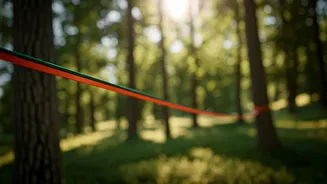
Imagine a tightrope, but friendlier. Slacklining involves balancing on a two-inch-wide strip of nylon webbing suspended between two anchor points, usually trees. Unlike a tightrope, which is pulled taut and static, a slackline has give. It dips, sways,
and wobbles with your every movement, forcing your body to constantly adapt. This dynamic tension is what makes it both a challenge and an incredibly effective workout. Originating as a pastime for rock climbers in the 1970s, it has grown into a worldwide activity prized for its fitness and meditative benefits.
The Core of the Matter
If you dread the monotony of sit-ups, slacklining might be the core workout you've been looking for. The instability of the line is the key. To stay upright, your body must make thousands of tiny, unconscious adjustments every second. This process fires up your deep core muscles—the abs, obliques, and lower back—in a way that static floor exercises can't replicate. These muscles are engaged constantly to stabilize your spine and pelvis, providing a functional strength that translates to better posture and a reduced risk of back pain. An instructor noted that beginners, in particular, will feel the burn in their core for the first six weeks as their body adapts.
More Than Just Abs
While the core benefits are significant, slacklining is a true full-body workout. Your legs work overtime, with your quads, glutes, and stabilizer muscles around the ankles and knees constantly engaged. Maintaining your balance also requires active use of your arms and shoulders, which you use to counterbalance the line's movement. Over time, this enhances your proprioception—your body's awareness of its position in space—which can improve performance in other sports and reduce the risk of injury in daily life. It’s a low-impact activity, making it gentler on the joints than running.
A Moving Meditation
The benefits of slacklining extend beyond the physical. The intense focus required to balance on the wobbly line has been described as a form of “moving meditation.” To succeed, you have to quiet your mind, control your breathing, and stay present in the moment. This concentration can help reduce stress and improve your ability to focus in other areas of your life. The challenge is often more mental than physical, teaching patience and resilience as you learn to find stillness amidst the wobble.
How to Get Started
Getting into slacklining is relatively simple. All you need is a basic slackline kit, which typically includes the webbing and a ratchet system for tensioning, and two sturdy anchor points. For beginners, it's best to start with a short, low-to-the-ground line. Focus on a fixed point in front of you, not your feet. Keep your knees bent, arms raised for balance, and take it slow. At first, just trying to stand on one foot is a great exercise. Having a friend to hold onto can help build confidence in the early stages. Remember that wobbling is a normal and necessary part of the learning process.