








The Silent Crisis of Hidden Hunger
On the surface, India is a food powerhouse, a leading global producer of grains, fruits, and vegetables. Yet, a paradoxical crisis is unfolding. It's called "hidden hunger," a form of malnutrition that doesn't necessarily come from a lack of food, but
from a lack of nutrients. It is estimated that over 80% of the Indian population suffers from deficiencies in crucial micronutrients like iron, zinc, folate, and various vitamins. This isn't about empty stomachs, but about diets dominated by a few staple crops, like rice and wheat, that provide calories but not the full spectrum of nutrients needed for healthy development and a strong immune system. The consequences are severe, leading to stunted growth in children, increased vulnerability to illness, and reduced productivity in adults, quietly undermining the nation's health and economic potential.
Our Shrinking Plates and Fields
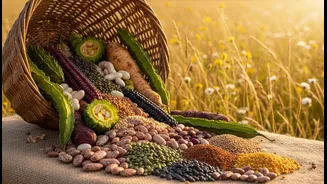
The problem of hidden hunger is directly linked to a decline in agricultural biodiversity. The Green Revolution, while critical for achieving food self-sufficiency, inadvertently pushed Indian agriculture towards a monoculture system focused heavily on high-yield rice and wheat. This focus, reinforced by government procurement policies and subsidies, made growing these staples a safe and reliable choice for farmers. As a result, countless traditional and local crop varieties—nutrient-dense millets, pulses, and indigenous vegetables that once formed the backbone of regional diets—have seen their cultivation area shrink dramatically. Globally, it is estimated that just three crops—rice, wheat, and maize—provide nearly 60% of the plant-derived calories we consume, making our food system vulnerable and our diets less nutritious. This narrowing of our food basket is a primary driver of widespread micronutrient deficiencies.
The Farmer's Market Dilemma
While encouraging farmers to diversify their crops seems like a straightforward solution, the reality is far more complex. The single biggest hurdle is the lack of a reliable and profitable market for diverse produce. Farmers are rational economic actors; they will grow what they know they can sell. For decades, the system has been geared towards procuring rice and wheat, offering a guaranteed Minimum Support Price (MSP) and an established network of mandis. For a farmer considering planting millets, legumes, or local vegetables, the path is fraught with uncertainty. They face fragmented supply chains, a lack of storage facilities (especially cold storage for perishables), and a high number of middlemen who reduce their profit margins. Without a guaranteed buyer, price stability, and proper infrastructure, diversifying crops is a significant financial risk that most small and marginal farmers simply cannot afford to take.
Building Bridges to a Diverse Market
The solution lies in creating robust market linkages that make growing diverse crops as economically viable as growing staples. Government initiatives like the Crop Diversification Programme (CDP) are a step in the right direction, aiming to shift farmers away from water-intensive crops in states like Punjab and Haryana. However, a broader ecosystem is needed. Farmer Producer Organizations (FPOs) are emerging as a powerful tool, allowing small farmers to pool their produce, bargain collectively for better prices, and access larger markets. FPOs can invest in shared processing and storage facilities, add value to raw produce, and connect directly with businesses, bypassing exploitative intermediaries. Furthermore, a growing consumer awareness of health and nutrition is creating new demand for traditional grains and organic produce, which can be harnessed through direct-to-consumer models and dedicated retail platforms.