





The Sun's Hidden Engine Room
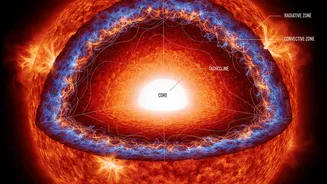
Deep inside the Sun, about 200,000 kilometres below the surface we see, lies a boundary layer that has puzzled scientists for decades. This layer is called the tachocline. Think of it as a massive internal jet stream. Above it, in the convection zone,
the Sun’s plasma churns and boils like water in a pot, rotating faster at its equator than at its poles. Below it, in the radiative zone, the Sun rotates more like a solid, spinning ball. The tachocline is the incredibly thin, turbulent shear layer that separates these two distinct zones. It’s a region of immense friction and stress, where the rotational speed changes dramatically. This unique environment is believed to be the engine that powers the Sun's magnetic activity.
Why It's a Forecasting Game-Changer
The tachocline is thought to be the heart of the solar dynamo—the process that generates the Sun’s powerful magnetic field. The intense shearing motion in this layer stretches and amplifies magnetic field lines, eventually leading to the creation of sunspots, solar flares, and coronal mass ejections. These are the very phenomena that constitute 'space weather,' which can disrupt satellites, GPS navigation, and even power grids on Earth. The problem for forecasters is that we can't see the tachocline directly. We primarily observe the effects on the solar surface. This is like trying to predict a hurricane's path by only looking at the clouds on top, without understanding the powerful ocean currents below. Better understanding of the tachocline could dramatically improve long-term space weather prediction, moving from days to potentially weeks or months of advance warning.
Current Forecasts: A Surface-Level View
Today’s solar forecasting models are sophisticated but limited. They fall into a few main categories. Physical models use the laws of physics to simulate solar processes, but they are incredibly complex and require precise information that is hard to get. Statistical models, like the time-series methods used in economic forecasting, look for patterns in historical data of solar activity to predict the future. More recently, Artificial Intelligence (AI) and machine learning models are being trained on vast amounts of solar observation data to find complex, non-linear patterns that older methods might miss. However, all these models largely rely on what we can see: the sun's surface and atmosphere. Their accuracy fades significantly with longer forecast horizons because they are not fully accounting for the root cause of the activity in the deep interior.
The Limits of Looking from Afar
The biggest limitation of current models is their inability to fully incorporate the physics of the tachocline. Because this region is opaque, scientists rely on indirect methods like helioseismology—studying sound waves that travel through the Sun—to infer its properties. Recent research has provided strong evidence that the solar dynamo, which drives the 11-year solar cycle, has a deep-seated origin near the tachocline, rather than being a shallow surface phenomenon. Models that don't account for this deep driver will always struggle with long-term accuracy. They are good at predicting what an active region on the surface might do in the next few hours or days, but they are poor at predicting when and where those active regions will form in the first place.
Model Advances: Peering into the Depths
The frontier of solar science is developing new models that can simulate the dynamics of the tachocline. Researchers are creating complex 3D magnetohydrodynamic (MHD) simulations to understand how magnetic fields are generated and confined within this thin layer. Some theories propose that magnetically modified Rossby waves—similar to the jet stream waves that shape weather on Earth—originate in the tachocline and are key to triggering solar storms. By including these deep-seated physical processes, scientists hope to build a new generation of forecast models. The goal is to move beyond simply observing surface features and toward a system that models the entire solar engine, from the tachocline to the corona. These advances aim to create forecasts that are not only more accurate but also provide much longer lead times.