





A Water World Like No Other
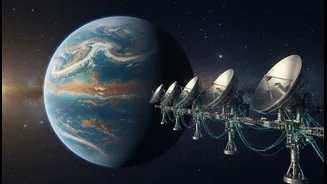
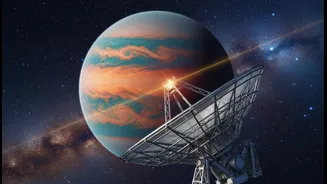
K2-18b is what is known as a 'sub-Neptune'—a planet larger than Earth but smaller than Neptune, a category of world we don't have in our own solar system. It's about 8.6 times the mass of Earth and orbits its cool red dwarf star within the habitable zone,
the region where temperatures could allow for liquid water. This has led to the exciting hypothesis that K2-18b could be a 'Hycean' world: a planet with a hydrogen-rich atmosphere covering a global water ocean. Observations from the James Webb Space Telescope (JWST) have lent weight to this idea, detecting key carbon-bearing molecules like methane and carbon dioxide in its atmosphere, consistent with the presence of an ocean.
A Tantalizing Hint of Life
The real excitement began when JWST data revealed a potential trace of dimethyl sulfide (DMS), a gas that on Earth is almost exclusively produced by life, primarily marine phytoplankton. This possible detection of a biosignature—a substance that provides evidence of life—immediately made K2-18b one of the most compelling targets in the search for extraterrestrial life. However, the scientific community remains divided. The DMS signal is faint and not statistically significant enough for a definitive discovery, with multiple independent analyses of the same data failing to confirm its presence. The debate is not yet about whether there is life, but whether the molecule itself is even there.
The Search for a Clearer Signal
Confirming a faint signal from a planet 124 light-years away is an immense technological challenge. The initial hints of DMS in K2-18b's atmosphere were captured by JWST's infrared instruments, which analyze starlight filtering through the planet's atmosphere. But even with Webb's unprecedented sensitivity, the signal is weak and subject to interpretation, with some scientists arguing it could be a statistical fluke or another chemical compound entirely. To move from a tantalizing hint to a confirmed discovery, a different approach is needed—one that can offer an even higher degree of precision to either validate the DMS signal or rule it out completely.
Enter the Radio Giants
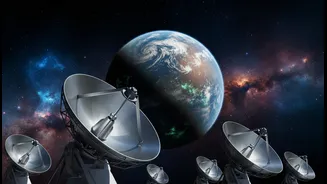
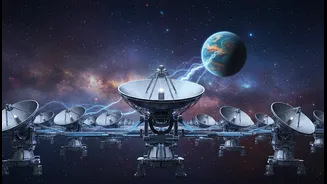
This is where the headline's 'massive radio survey' comes into play. Recently, a team of researchers conducted an exceptionally sensitive search of the K2-18b system using two of the world's most powerful radio telescope networks: the Very Large Array (VLA) in New Mexico and the MeerKAT telescope in South Africa. This survey wasn't looking for the chemical signature of DMS in the atmosphere, but rather for 'technosignatures'—narrowband radio signals that could indicate the presence of technology. While distinct from the atmospheric analysis performed by JWST, this effort represents a critical and complementary method in the search for life.
A New Era of Listening
The coordinated radio survey of K2-18b identified millions of potential signals, which were then rigorously filtered by advanced software to eliminate Earth-based interference and other false positives. In the end, no convincing artificial radio transmissions were found. While this means K2-18b is not broadcasting any obvious technological signals comparable to our own, the project was a resounding success in another way. It demonstrated a powerful new technique for conducting SETI (Search for Extraterrestrial Intelligence) searches with incredible speed and efficiency. This method of combining large arrays and using automated filtering will be essential for future, even larger projects like the Square Kilometer Array, proving that we are getting much better at listening for signs of life, even if this particular search came up empty.