





A Legacy of Success
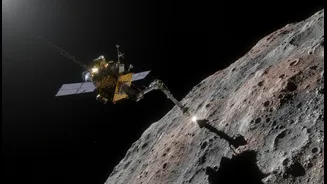
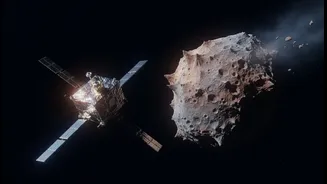
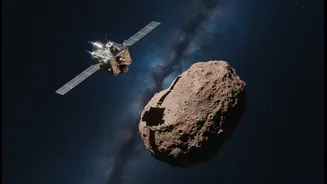
To understand the boldness of this new mission, one must remember Hayabusa2’s first act. Launched in 2014, the spacecraft arrived at the near-Earth asteroid Ryugu in 2018. Over a year and a half, it didn't just orbit; it deployed rovers, fired a projectile
to create an artificial crater, and, most importantly, collected samples from both the surface and the freshly exposed subsurface. In December 2020, it successfully returned these precious materials to Earth, offering humanity an unprecedented look at the building blocks of our solar system. The samples revealed organic molecules and water-bearing minerals, providing clues about the origins of life. Having achieved every primary objective and more, the Japan Aerospace Exploration Agency (JAXA) decided that the still-healthy spacecraft, with half its fuel remaining, would embark on an encore performance.
The Scientific Benefits: Why Torifune?
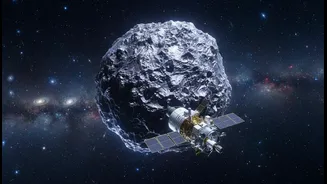
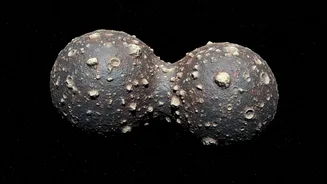
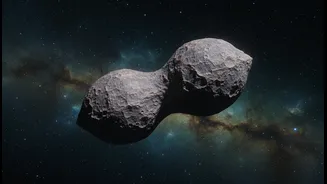
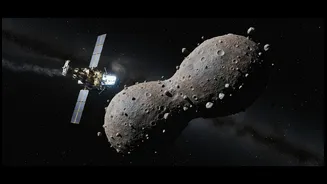
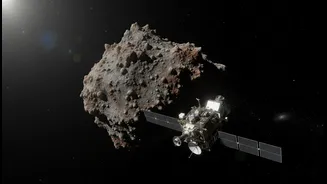
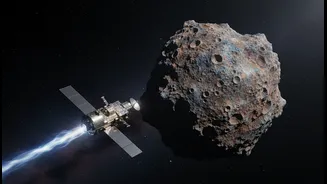
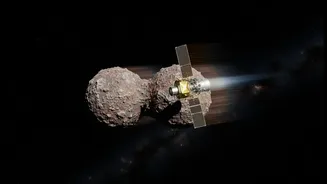
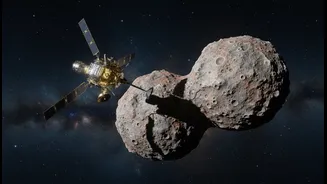
The extended mission, dubbed Hayabusa2# (pronounced 'sharp'), has two primary targets. The first is the flyby of asteroid 98943 Torifune (also known as 2001 CC21) in July 2026. This is not just a random rock; it's a scientifically compelling target. Unlike the C-type (carbonaceous) asteroid Ryugu, Torifune is an S-type, or silicate-rich, asteroid. Studying it allows for a direct comparison between two different types of asteroids, enriching our understanding of solar system diversity. Furthermore, Torifune is an elongated, possibly contact binary asteroid, meaning it might be two smaller bodies stuck together. Observing such a structure up close provides invaluable data on how small celestial bodies collide and grow into larger objects, a key process in planet formation. Images from the flyby can reveal surface features, composition, and the effects of space weathering, painting a complete picture of this new world.
The Risks: A High-Speed Gamble
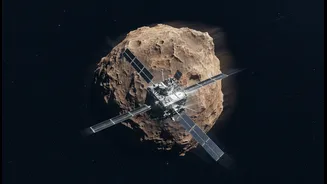
The Torifune flyby is an immense technical challenge, primarily because Hayabusa2 was never designed for this. The probe was built for slow, deliberate rendezvous maneuvers—matching an asteroid's orbit and hovering. This flyby is the exact opposite: a blistering high-speed encounter at a relative velocity of about 18,000 kilometres per hour (5 km/s). At that speed, the entire close encounter is over in minutes. The spacecraft has fixed cameras, meaning it can't simply track the asteroid as it zips by; the entire probe must be oriented correctly. This requires incredibly precise autonomous navigation, as the spacecraft must lock onto the faint, dark asteroid just days before the flyby and make last-minute trajectory corrections. JAXA is pushing the aging hardware into a higher-than-designed thermal environment, and the maneuver is so precise it has been compared to hitting a coin in Hokkaido from Okinawa. A miscalculation could mean missing the target entirely or, worse, a collision.
Practical Next Steps: Planetary Defense and a Final Target
The immediate next step after the flyby is data transmission. Hayabusa2 captured a wealth of scientific data and stunning images, which are being sent back to Earth for analysis by scientists globally. However, the mission's practical applications go beyond pure science. This high-speed intercept is a crucial dry run for planetary defense. It tests the exact technologies needed to autonomously guide a probe to intercept a potentially hazardous asteroid on short notice. Successfully tracking and maneuvering around a fast-moving object proves the guidance systems that would be essential for a future kinetic impactor mission, designed to deflect an asteroid threatening Earth. After its Torifune encounter, Hayabusa2 is not done. It will perform two Earth swing-bys in 2027 and 2028 to set its course for its final destination: a 2031 rendezvous with 1998 KY26, a tiny, rapidly rotating asteroid that will be the smallest ever visited by a spacecraft.