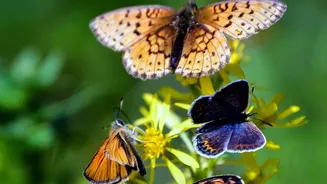








The flutter of a butterfly is a magical moment in any garden. But what if you could see them more clearly, in all their shimmering glory? The secret isn't just about where you look, but when, and it’s all tied to the angle of the sun.
The Magic of Morning and Evening
Ask any photographer
and they will tell you about the 'golden hours'—the periods shortly after sunrise and before sunset when the sun is low in the sky, casting a warm, soft light. This same principle is a game-changer for butterfly watchers. Butterflies, being cold-blooded, are most active during the warmest parts of a sunny day, typically from late morning to early afternoon. While this is a great time to see them flitting about, the low-angled light of the morning and late afternoon is when their colours truly come alive in a different way. The oblique angle of the sun acts like a spotlight, illuminating the intricate details of their wings and revealing hidden sheens and flashes of colour you might otherwise miss under the harsh glare of the midday sun.
Pigment vs. Structure: The Science of Shimmer
To understand why light angles are so important, we need to look at how butterfly wings get their colour. It happens in two primary ways: pigments and structure. Pigmented colours are straightforward; they come from chemical compounds like melanin (which produces browns and blacks) that absorb certain wavelengths of light and reflect others. But the most dazzling, metallic, and iridescent colours—the electric blues, shimmering greens, and vibrant purples—are not from pigments at all. They are 'structural colours'. These are created by the microscopic architecture of the butterfly's wings. The wings are covered in thousands of tiny, overlapping scales, which themselves have nano-structures of chitin and air. These structures act like prisms or crystals, bending and scattering light waves.
Butterflies as Living Prisms
When light hits these microscopic structures, a phenomenon called interference occurs. Light waves bounce off multiple layers within a single scale. Depending on the angle of the light and your viewing angle, some light waves are cancelled out while others are amplified, resulting in an intensely vibrant colour. This effect is called iridescence. It’s why a Blue Morpho butterfly can look brilliant blue from one angle, but almost dull brown from another. As the butterfly moves its wings, or as the sun’s angle shifts, the colours can appear to flash, change, or even disappear entirely. This is a survival mechanism, helping the butterfly to confuse predators during flight. For the garden observer, it means that a slight shift in your position or the time of day can reveal a completely different spectacle.
Practical Tips for Optimal Viewing
To harness this effect, position yourself so the sun is at a low angle, either behind you or to your side. Backlighting, where the sun is behind the butterfly, can be particularly magical. It can make the edges of the wings glow and highlight the fine, hair-like scales on their body. Try to be still; sudden movements and even your shadow can startle a resting butterfly. Calm, sunny days are best, as butterflies often hide from wind and rain. While midday is peak activity time, dedicate some observation time to the hours between 8 and 10 a.m. or after 4 p.m. on a warm day. You’ll be rewarded with deeper, more dynamic colours as the angled light interacts with their incredible wings.
Design Your Garden for a Dazzling Display
You can also design your garden to create a natural theatre for butterflies. Plant nectar-rich flowers like asters, coneflowers, and milkweed in spots that receive at least six hours of direct sun, especially morning sun. Place flat stones or rocks in these sunny areas; butterflies use these surfaces to bask and warm their flight muscles. A patch of damp sand or a shallow dish with mud can also attract them, as they often 'puddle' to extract minerals and water. By creating a habitat that provides food, warmth, and shelter, and observing it during the magic hours of light, you turn your garden into a front-row seat for one of nature’s most beautiful light shows.