

The Great Cosmic Tug-of-War
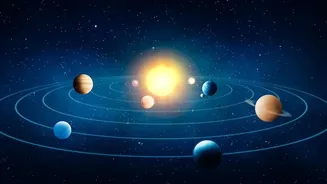
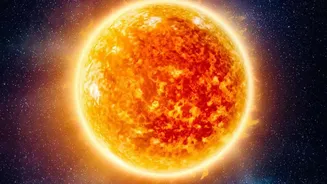
Imagine a constant tug-of-war happening in space. On one side, you have the Sun’s immense gravity, a powerful force that constantly pulls planets toward it. On the other side is the planet's inertia, which is its tendency to keep moving in a straight
line at a constant speed. An orbit is the result of a perfect balance between these two competing effects. Without gravity, a planet would travel in a straight line forever, disappearing into the cosmos. Without the planet's forward motion, gravity would win, and the planet would fall directly into the Sun. Together, they create a stable, repeating path called an orbit.
Newton’s Groundbreaking Idea
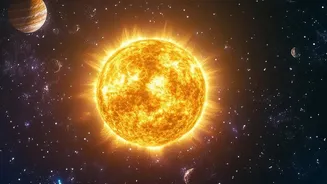
More than 300 years ago, Sir Isaac Newton had a revolutionary insight. He proposed that the same force that makes an apple fall from a tree to the ground is the very same force that keeps the Moon in orbit around the Earth, and the planets around the Sun. He called this 'universal gravitation'. His law states that every object with mass attracts every other object. The strength of this attraction depends on two things: how massive the objects are and how far apart they are. The Sun is incredibly massive—it contains more than 99% of all the mass in our solar system—so its gravitational pull is enormous, acting like an invisible tether holding all the planets in their paths.
The Importance of Moving Sideways
So why don't planets just fall into the Sun? Because they are also moving very, very fast in a direction that is roughly perpendicular to the Sun's pull. This 'sideways' motion is called tangential velocity, and it's a critical part of the equation. Newton realized that an orbit is essentially a state of continuous free-fall. You can picture this by imagining throwing a ball. The harder you throw it, the farther it travels before hitting the ground. If you could throw it fast enough from a high enough point, its forward speed would perfectly match the rate at which it falls toward Earth. It would keep falling, but it would also keep missing the ground, endlessly circling the planet. This is exactly what’s happening with the planets—they are constantly falling toward the Sun but moving sideways so fast that they always miss.
Einstein's Warped Reality
For centuries, Newton's idea of gravity as a force was the best explanation we had. But in the early 20th century, Albert Einstein offered an even deeper understanding with his theory of general relativity. Einstein suggested that gravity is not a force at all. Instead, massive objects like the Sun actually bend and curve the very fabric of space and time (which he called spacetime) around them. A common analogy is to picture a heavy bowling ball placed on a stretched rubber sheet. The bowling ball creates a deep well in the sheet. Now, if you roll a marble nearby, it won't travel in a straight line; instead, it will follow the curve created by the bowling ball, spiraling around it. In this view, planets aren't being pulled by a force; they are simply following the straightest possible path through the curved spacetime created by the Sun.