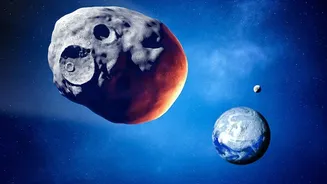

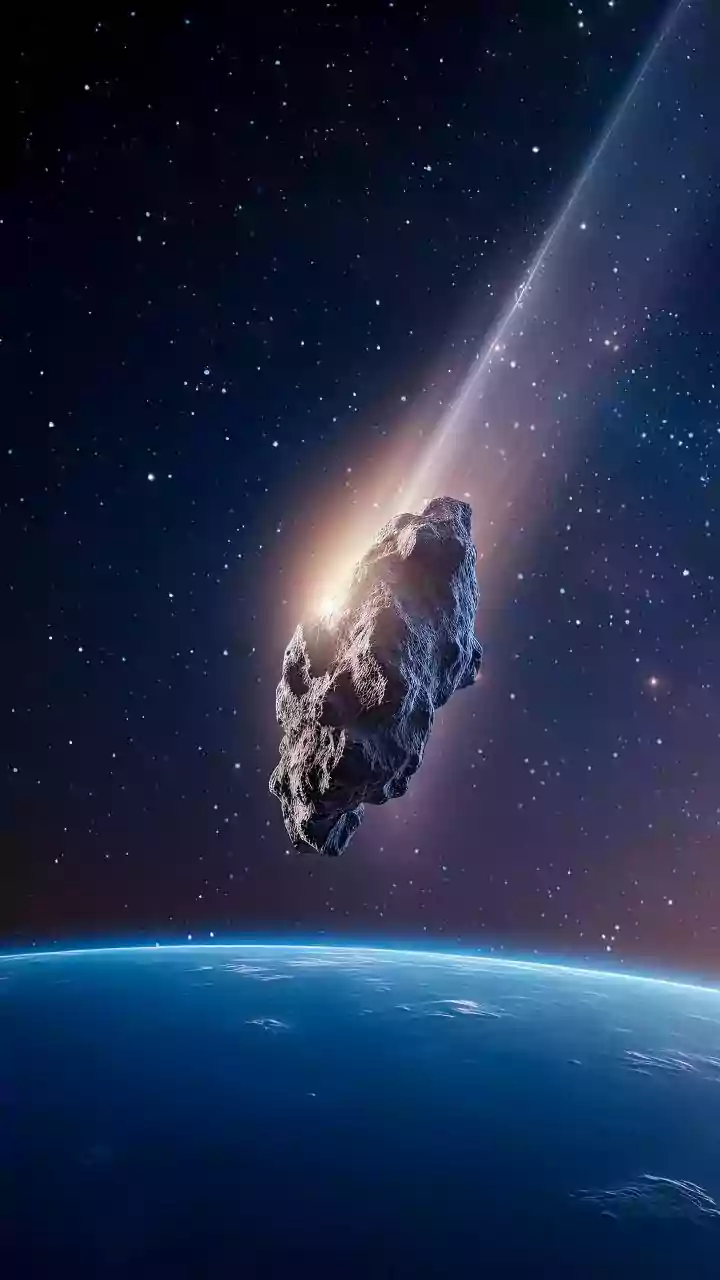


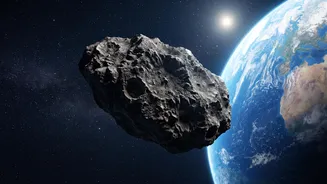
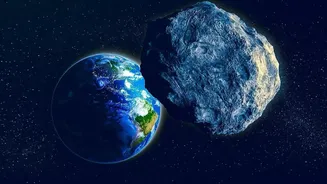
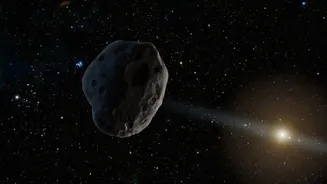
Look up. Our familiar Moon has a visitor. A tiny asteroid, dubbed 2026 QQ8, was captured by Earth's gravity and is acting as a temporary 'mini-moon'. But this cosmic guest is preparing to say goodbye, with its departure expected in early December.
What Exactly Is This Mini-Moon?
Don't
expect to see a second giant orb in the night sky. The object designated 2026 QQ8 is a very small asteroid, estimated to be only about six feet in diameter. It was captured by Earth's gravity sometime in the middle of 2026 and has been our planet's companion ever since. The term 'mini-moon' isn't an official astronomical classification, but it's a fitting nickname used by scientists for small, natural objects that are temporarily pulled into orbit around our planet. Discoveries like this are often made by dedicated sky surveys that scan the heavens for near-Earth objects. Initially, astronomers had to carefully track 2026 QQ8 to confirm it was a natural asteroid and not a piece of old space junk or a defunct satellite, a process that took several weeks.
The Science of a Temporary Moon
So how does a planet like Earth get a temporary moon? It’s a delicate cosmic dance. The solar system is filled with asteroids orbiting the Sun. Occasionally, one of these space rocks, known as a near-Earth object, will have an orbit that brings it close to us. If it approaches at just the right speed and trajectory—not so fast that it zips past, and not so slow that it gets pulled in completely—it can be gently snagged by Earth's gravitational pull. Our planet's gravity, with a little help from our main Moon's gravity, can nudge the asteroid out of its solar orbit and into a temporary, often chaotic, loop around Earth. This capture is usually short-lived, lasting anywhere from a few weeks to several months, or in rare cases, a few years.
A Short and Wobbly Journey
Unlike our large, stable Moon, the orbits of mini-moons are wobbly and unpredictable. They are only weakly bound to Earth's gravity. Think of it less like a perfect circle and more like a complex, looping path that can extend far out, even beyond the orbit of our primary Moon. These temporary companions are in a constant gravitational tug-of-war between the Earth, the Moon, and the Sun. While they are captured by Earth, they are still technically orbiting the Sun as well. Their time with us is a temporary detour on their much longer journey through the solar system. Previous examples, like 2006 RH120 and 2020 CD3, followed similar patterns, orbiting Earth for about a year and three years, respectively, before being flung back out into space.
Why Our Mini-Moon Is Leaving
The same gravitational forces that capture a mini-moon are also responsible for its departure. An object in such a fragile orbit only needs a slight gravitational nudge to be set free. As 2026 QQ8 continues its looping path, its trajectory will eventually carry it to a point where the Sun's gravity reasserts its dominance, or a nudge from the Moon's gravity gives it the push it needs to escape Earth's influence. Once it crosses that threshold, it will break free from its temporary earthly orbit and resume its journey as a solar-orbiting asteroid. Astronomers predict this will happen for 2026 QQ8 in early December, ending its brief tenure as our planet's second satellite.
Can You See It Before It Goes?
Unfortunately, catching a glimpse of our departing guest is not possible for amateur skywatchers. At just a few feet across and incredibly far away, 2026 QQ8 is far too small and dim to be seen with the naked eye or even a standard backyard telescope. For perspective, it's roughly one million times fainter than the faintest star you can see in a dark sky. Its detection required powerful, professional telescopes used by observatories that specialize in finding and tracking such faint objects. So while it’s a fascinating event, our mini-moon will remain an invisible companion until it slips away, leaving us once again with just one Moon.