



The Cosmic Data Deluge
Modern space exploration is built on data. Telescopes, rovers, and satellites constantly beam back torrents of information, creating a challenge that is almost as immense as space itself. NASA has collected over 150 petabytes of data from decades of missions,
a volume so large that human analysis alone is no longer feasible. This data bottleneck has traditionally meant that discoveries could remain hidden for years within mission archives. The goal now is to use AI to shorten analysis timeframes from years to mere days, ensuring that scientists can keep pace with the information their instruments are gathering. It's about finding the cosmic needles—a new planet, a distant supernova, or signs of past life—in a haystack of galactic proportions.
The Genesis Mission: A National AI Push
To tackle this data challenge head-on, NASA has joined a major national initiative called the Genesis Mission. Launched by a presidential executive order in late 2025, this whole-of-government effort aims to leverage AI to accelerate scientific discovery across more than 15 federal agencies. For NASA, this means applying advanced AI tools to its massive data archives to uncover new knowledge. By partnering with institutions like the Department of Energy, NASA can combine its mission expertise with powerful supercomputing and AI capabilities. The goal is to create AI tools that can connect data from different missions and fields of study, identify hidden patterns, and improve predictions about everything from space weather to the formation of galaxies.
Smarter Rovers and Autonomous Spacecraft
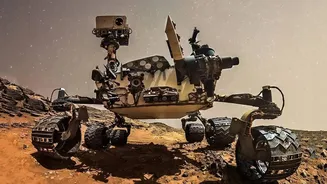
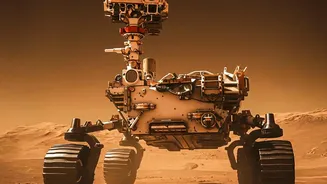
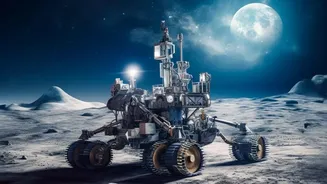
On the ground and in deep space, AI is making NASA's hardware more independent. The Perseverance rover on Mars, for example, relies heavily on AI for autonomous navigation. An impressive 88% of its driving is done autonomously, with the rover using its cameras and an onboard computer to identify and navigate around hazards on terrain no human has ever seen. Its PIXL instrument even uses AI to select and analyze rock samples that might contain signs of ancient life. Beyond rovers, NASA is developing new, radiation-hardened computer chips that can deliver hundreds of times the performance of current spaceflight computers. This technology could enable spacecraft to make their own decisions in deep space, such as identifying a volcanic eruption and deciding to focus its instruments on it, all without waiting for commands from Earth.
Discovering New Worlds at High Speed
One of the most exciting applications of AI is in the hunt for exoplanets—planets orbiting other stars. Missions like Kepler and the Transiting Exoplanet Survey Satellite (TESS) have generated an incredible amount of data by monitoring the brightness of millions of stars. AI models are perfectly suited for sifting through these light curves to spot the telltale dip in brightness caused by a transiting planet. An AI tool called ExoMiner recently identified hundreds of new exoplanets by analyzing data from the Kepler telescope. More recently, another AI system named RAVEN confirmed over 100 exoplanets, including 31 entirely new worlds, from TESS data. These AI systems can spot planets that human analysts might miss and do so with greater speed and accuracy, accelerating the pace of discovery.
Augmenting Human Ingenuity
Despite the power of these advanced systems, the goal is not to replace human scientists but to augment their capabilities. AI handles the laborious task of data-sifting, freeing up researchers to focus on interpretation, hypothesis, and the bigger picture. The ExoMiner system, for example, helps scientists by flagging potential planet candidates, which are then verified. This human-AI partnership allows for more accurate and reliable discoveries than either could achieve alone. By automating routine tasks, from scheduling mission operations to managing spacecraft health, AI enables NASA’s human experts to work more efficiently and focus on the creative problem-solving that leads to true breakthroughs in our understanding of the universe.