



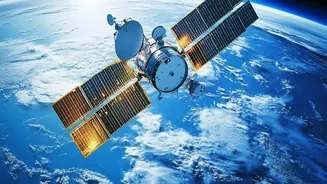
The Old Guard: Radio's Reliable Reign
Since the dawn of the space age, radio frequency (RF) communication has been the trusted workhorse for sending commands to spacecraft and receiving precious data back on Earth. Think of it as the original interstellar telephone line. It’s incredibly reliable
and can travel vast distances. However, it has a fundamental limitation: bandwidth. As our scientific instruments become more advanced, they generate enormous amounts of data—high-resolution images, complex geological scans, and detailed atmospheric readings. Sending this information back via radio waves is like trying to push a river through a garden hose. For instance, NASA's Mars Reconnaissance Orbiter can take hours to transmit a single high-resolution image of the Martian surface. This data bottleneck has long limited the potential scientific return of many missions.
Enter the Challenger: Communicating with Light
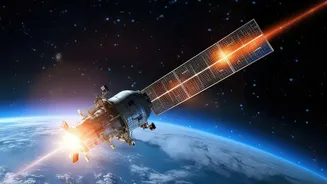
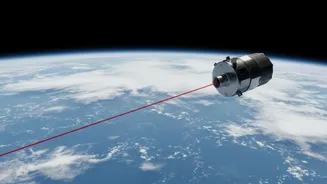
The next leap forward isn't an evolution of radio, but a complete shift in approach: Deep Space Optical Communications (DSOC). Instead of radio waves, this technology uses infrared lasers to encode and transmit data. It operates on the same basic principle as fiber optics on Earth, but without the cable. By modulating information onto a beam of light—which has a much higher frequency than radio waves—engineers can pack significantly more data into the same transmission window. This allows for data rates 10 to 100 times greater than the best radio systems available today. It’s the difference between dial-up internet and modern broadband, but on a cosmic scale.
Putting Lasers to the Ultimate Test
This isn't just theory; NASA has successfully proven the technology works in the harshest environment imaginable. The agency’s DSOC experiment, flying aboard the Psyche spacecraft on its way to a metal-rich asteroid, has been shattering records. In one of its earliest tests, when it was 19 million miles from Earth, the system beamed an ultra-high-definition video of a cat named Taters back to Earth at a stunning rate of 267 megabits per second (Mbps)—a speed comparable to a home broadband connection. This was the first time UHD video was streamed from deep space.
Pushing the Boundaries of Distance and Speed
As the Psyche spacecraft traveled farther, the DSOC experiment continued to prove its worth. From 140 million miles away—a distance one and a half times that between the Earth and the Sun—it successfully transmitted spacecraft data at 25 Mbps. Even as it reached the farthest points of its test window, hundreds of millions of miles away, the laser link maintained data rates significantly faster than what a comparable radio system could achieve. In total, the experiment transmitted an incredible 13.6 terabits of data, proving that laser communications are not only viable but robust over interplanetary distances.
The Future of Interplanetary Exploration
The success of DSOC marks a pivotal moment for space exploration. With higher bandwidth, future missions to Mars could send back daily high-definition video, allowing scientists and the public to experience the Red Planet in unprecedented detail. Instead of waiting weeks to receive a full map of a planet's surface, it could be done in days. This technology also enables more complex scientific instruments that were previously impractical due to data transmission limits. Furthermore, laser communication systems are smaller, lighter, and require less power than their radio counterparts, freeing up valuable mass and energy for more science on future spacecraft. This isn't just an upgrade; it’s a foundational capability that will support humanity’s next giant leaps, including sending humans to Mars.