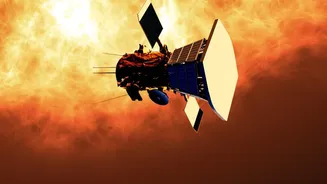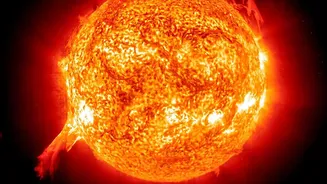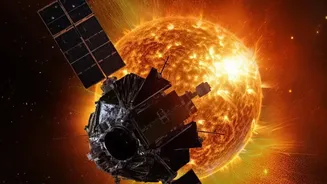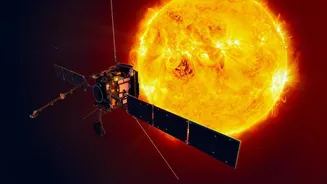




In a major leap for solar science, India's Aditya-L1 mission and Europe's Proba-3 have joined forces. This powerful collaboration combines the unique capabilities of two advanced spacecraft to solve one of the Sun's most enduring mysteries.
India’s Eye on the Sun
Launched by
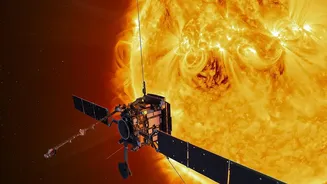
the Indian Space Research Organisation (ISRO), Aditya-L1 is the nation's first dedicated solar observatory. It is strategically positioned at Lagrange point 1 (L1), a stable location about 1.5 million kilometres from Earth, which allows for a continuous, uninterrupted view of the Sun. Among its suite of seven instruments, the Visible Emission Line Coronagraph (VELC) is a key player in this new study. The VELC is designed to observe the Sun's corona, its superheated outer atmosphere, which is normally hidden by the intense glare of the solar surface. It does this by using spectroscopy, a technique that splits light into its various wavelengths to analyse the properties of the plasma, like its temperature and density.
Europe's Artificial Eclipse
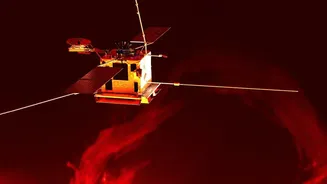
The European Space Agency's (ESA) Proba-3 mission is an engineering marvel. It is the world's first precision formation-flying mission, consisting of two separate satellites flying in perfect alignment. One satellite acts as an 'occulter', positioning itself to block the bright disc of the Sun, while the second satellite, equipped with a coronagraph called ASPIICS, observes the faint corona. This creates a highly precise, long-duration artificial solar eclipse in space, allowing scientists to see the corona extremely close to the Sun's surface—a region critical for understanding where solar eruptions are born. This unique capability offers a view that is nearly impossible to get from Earth-based or single-spacecraft observatories.
A Powerful Scientific Partnership
The real breakthrough comes from combining the data from these two missions. While Proba-3 provides incredibly sharp, close-up images, Aditya-L1’s VELC provides spectroscopic data that reveals the physical properties of the solar material. Think of it like having two different types of vision: Proba-3 shows the precise shape and movement of an eruption, while Aditya-L1 tells us how hot it is and how dense the material is. This synergy allows for a much more complete and cross-checked understanding of solar events. Scientists from the Indian Institute of Astrophysics (IIA) in Bengaluru, along with international collaborators, have already begun analysing joint observations, focusing on Coronal Mass Ejections (CMEs).
Unlocking Coronal Mysteries
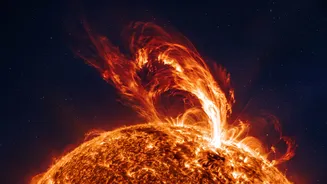
The primary target of this joint study is Coronal Mass Ejections, which are colossal eruptions of plasma and magnetic fields from the Sun. By studying two CMEs observed in September 2025, scientists were able to measure their mass, speed, and energy with greater accuracy than ever before. The observations revealed two different types of events: one fast_moving CME and one much slower one, each showing different expansion patterns. VELC was able to catch the eruptions in their very early stages, while ASPIICS tracked their shape and structure as they moved outward. By combining these views, researchers can better constrain their models and understand how the energy of an eruption is distributed and evolves.
Why This Matters for Earth
Studying CMEs isn't just an academic exercise. When these eruptions are aimed at Earth, they can trigger geomagnetic storms that disrupt our planet's magnetic field. This 'space weather' can have serious consequences, posing a risk to orbiting satellites, disrupting GPS and communication signals, threatening the safety of astronauts, and even straining power grids on the ground. By understanding the origin and early behaviour of CMEs, scientists hope to improve their ability to forecast space weather events. This India–Europe collaboration is a crucial step toward that goal, demonstrating the power of international cooperation in tackling complex scientific challenges that have a direct impact on our technologically dependent society.