







A New Sentry for India
The EOS-05 is a state-of-the-art Earth Observation Satellite, another proud moment for the Indian Space Research Organisation (ISRO). Think of it as a highly advanced, dedicated camera positioned far above us. Its primary mission is to provide continuous,
real-time imagery of the Indian subcontinent. This isn't for your holiday pictures, though. This satellite is designed for critical applications: monitoring weather patterns, providing early warnings for natural disasters like cyclones and floods, tracking forest fires, and offering vital data for agriculture and environmental management. It also serves important strategic purposes, enhancing our nation's security and surveillance capabilities.
The High Road: What is a Geosynchronous Orbit?
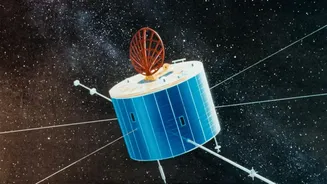
Most earth observation satellites, like the ones you might have heard of for mapping, fly in Low Earth Orbit (LEO), just a few hundred kilometres up. They zip around the planet quickly, capturing high-resolution images but only passing over the same spot periodically. EOS-05, however, was sent on a much longer journey to a geosynchronous orbit, some 36,000 kilometres away. An orbit is called geosynchronous when the satellite takes exactly 24 hours to circle the Earth – the same amount of time it takes our planet to complete one rotation. This precise timing is the secret to its unique capability.
Staying in Sync with Earth
Within the broader category of geosynchronous orbits is a very special path called a geostationary orbit (GEO). A satellite in a circular GEO, directly above the equator, appears to hover motionlessly in the sky from our perspective on the ground. This is because its orbital speed perfectly matches Earth's spin. It’s like two cars driving next to each other at the exact same speed; to the passengers, the other car seems to stand still. For a satellite whose job is constant monitoring, this is the ultimate vantage point. While EOS-05 is in a geosynchronous path, it offers this same fundamental benefit of remaining over one region.
Why This Orbit Was the Only Choice
The mission dictates the orbit, and for EOS-05, a fixed viewpoint is non-negotiable. To track the rapid development of a cyclone, monitor the spread of a forest fire, or provide immediate data after an earthquake, you need an unblinking eye. A satellite in LEO might see an event, but then it's gone, and won't be back over the same spot for hours or even days. A satellite like EOS-05, however, can provide a constant stream of images and data of the Indian subcontinent, enabling near real-time monitoring. This persistent gaze is what transforms it from a simple imaging satellite into a powerful tool for saving lives and protecting resources.
The Difficult Journey Up High
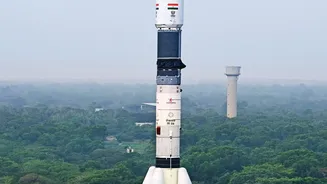
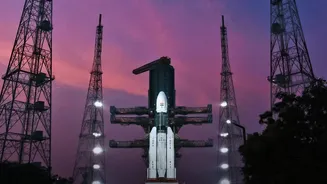
Placing a satellite into a geosynchronous orbit is a monumental task that showcases ISRO's technical prowess. It requires a powerful and reliable launch vehicle, which is why the Geosynchronous Satellite Launch Vehicle (GSLV) was used. The GSLV is designed specifically for these demanding missions, capable of providing the immense energy needed to push a heavy payload from the ground all the way to a transfer orbit 36,000 km away. The satellite is first injected into an elliptical 'transfer orbit', after which it uses its own onboard motors to perform a series of complex manoeuvres to circularise its path and settle into its final orbital slot. It's a high-stakes, high-reward journey that few space agencies can execute.
A Strategic Asset for India's Future
With EOS-05 now in position, India joins a select group of nations with the capability to continuously monitor its territory from a geostationary vantage point. This capability has far-reaching implications. For civilians, it means more accurate weather forecasts and better-coordinated disaster relief efforts. For the government, it provides a powerful tool for infrastructure planning, urban management, and environmental policy. And on a strategic level, it enhances our national security by providing a constant watch over our borders and maritime interests. The successful launch and placement of EOS-05 is not just a technological victory; it is a vital step forward in securing India's future.