



Discovering the Cosmic Fossils
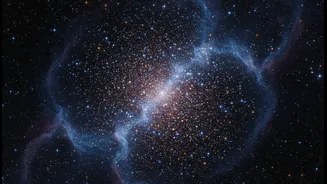
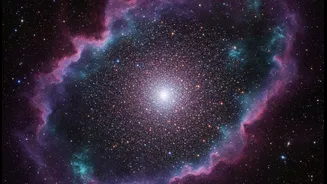
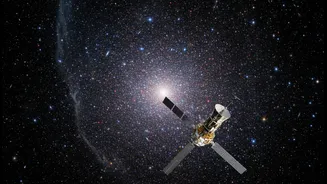
Imagine a dense, shimmering ball packed with half a million stars, all born when the universe was in its infancy. This is a globular cluster, and it's one of the oldest objects you can see in the cosmos. These clusters are spherical collections of stars tightly
bound by gravity, and they act as time capsules. Recent images from the Hubble Space Telescope have brought renewed attention to clusters like Messier 3 and NGC 6426. These objects are nearly 13 billion years old, meaning they formed just a few hundred million years after the Big Bang itself. Because all the stars in a cluster were born from the same cloud of gas at roughly the same time, they preserve a unique chemical and historical record of their environment from the dawn of the universe.
A Galaxy Built From Collisions
Our home galaxy, the Milky Way, seems like a serene and stable place. But its history was anything but peaceful. The leading theory of galaxy formation suggests that large galaxies grow through a process of cosmic cannibalism, consuming smaller dwarf galaxies over billions of years. In the early, crowded universe, these mergers were commonplace. When a large galaxy like the Milky Way pulls in a smaller one, its immense gravity rips the dwarf galaxy apart, scattering its stars into long, faint streams. It’s a messy and destructive process that erases most traces of the original smaller galaxy.
The Survivors of the Wreckage
While the dwarf galaxy's individual stars are torn away and assimilated, its globular clusters are a different story. These clusters are so dense and gravitationally compact that they can often survive the tidal forces of a galactic merger. They are like the indestructible black box recorders from a cosmic plane crash. After the host dwarf galaxy is shredded, its resilient globular clusters are left behind, captured in a new orbit around the larger, victorious galaxy. Today, many of the 150 or so globular clusters orbiting the Milky Way, particularly those in its vast outer halo, are suspected to be these kinds of hardy survivors from ancient collisions.
Decoding the Galactic DNA
This is where the detective work begins. How can astronomers tell if a cluster is a native of the Milky Way or an immigrant from another galaxy? The clues are in their 'DNA'—their chemical composition and their orbits. Immigrant clusters often have different chemical signatures or travel on unusual, tilted paths compared to the native population. Recent Hubble observations of Messier 3, for example, have revealed that it contains two distinct generations of stars. This has led scientists to suspect that M3 is not a single cluster but the merged remnant of two separate clusters that once belonged to a dwarf galaxy the Milky Way swallowed whole. This makes it a fossil of a fossil, a relic of an ancient galactic encounter.
The Rise of Galactic Archaeology
By identifying and studying these immigrant clusters, astronomers are engaging in a new field: galactic archaeology. Each cluster with a unique chemical fingerprint or a strange orbit is another piece of our galaxy's family tree. By cataloging them, scientists can begin to reconstruct the history of the mergers that built the Milky Way over billions of years. They can estimate how many smaller galaxies were consumed and when these cosmic feasts took place. It’s a painstaking process of reverse-engineering our galaxy's construction from the clues left behind in these ancient, glittering relics. They provide a physical record that helps confirm and refine our computer simulations of how the universe evolved.